Saturday, February 14, 2015

Highlights from Battle of the Bulge at Fort Indiantown Gap

So somehow the month of January got away from me. It might have been the 6 consecutive weeks of travel and events, or the snow, or the holiday recovery, or being sick...but it doesn't really matter. What actually matters is that every event was a blast, I don't regret a thing, and I feel super enthusiastic about getting some of my post backlog up and published!

But that's all coming later--today, I wanted to share some photos from my most recent excursion: the Battle of the Bulge event at Fort Indiantown Gap in PA. This was only my second WWII event, and was a completely different experience from the first. For starters, it was winter. Hooray for period outerwear! Whoo, we needed it! Second, unlike WWII Weekend at the MAAM, the Gap was only open to the public on Saturday (the last day of an almost week-long event); so instead of large public displays, for the most part this event was just reenactors doing their thing. It was super fascinating. I'll admit that I oscillated a lot between feeling in the thick of things and feeling like a complete outsider (an anthropologist of sorts, I suppose), but I enjoyed myself immensely.

Even better, I got some great shots! Which is more of a miracle than it may seem, because I shot exclusively with my retrofit Speed Graphic, which meant I was shooting blind a lot of the time.

Setting up the Speed Graphic on a bunk in the women's barracks before a night out shooting
As usual (because my camera is occupied during these events), I don't have very many pictures of myself, and none of me in action yet. I'm hoping to grab a few from other generous attendees, but in the meantime, here are some highlights from the event!

by the barracks


a knitting lesson

ATS forces drilling on post

Allied HQ, far left

Treatment of a stomach wound in the German field hospital

tending a head wound in the German field hospital
The Fort Indiantown Gap event is supposed to be based on the Battle of the Bulge, which took place in the Ardennes region of the Western Front (which includes Belgium, France, and Luxembourg) from December 1944 to January 1945. The German offensive hit American troops particularly hard, resulting in the highest US casualty rate of any operation during the war. While eventually a victory for the Allies, the Bulge was particularly grueling due in part to frigid temperatures, the high casualty rate, and contention among British and American leadership. Churchill called the Battle of the Bulge "undoubtedly the greatest American battle of the war and will...be regarded as an ever-famous American victory." 


German troops fighting in the Ardennes, 1944 (via Wikipedia)
I have been told that one of the things that makes the Gap event so neat is the tactical exercises, which allow reenactors to get into the nitty-gritty of battle. The event is held on a National Guard base, so units convoy up into the mountainous exercise area for the battle parts of the event, which last over two days. We faced some gruelingly low temperatures ourselves during those days, but unlike in 1945, the higher-ups cancelled the second day of the tactical for safety reasons. That was the day I was planning to go out, which was disappointing. Instead, I shot the smaller public battle demonstration held in a wooded area near the barracks (which is why my photos are full of brush). It wasn't exactly the Bulge, but it was still an adventure to run about getting knee-deep in snow to try and get the shot while staying out of the way of the oncoming line!

First men ahead of the main line


The Allied line moves forward


The remaining soldiers regroup towards the end of the skirmish--you can see the "casualties" in the distance to the right

Sunday, February 8, 2015

Eating My Words

"I just really hope we get some snow. I want dramatic snow pictures!" Might be something I said several times in the week leading up to my most recent excursion into the 1940s. Whoops?

clearing snow near the USS Constitution, via WBUR

On the other hand, I'm clearly not the only person to ever think the snow made for a dramatic setting. People have been capturing the perils and playtimes of snow days in Boston for over 100 years, which is pretty awesome. The Boston Public Library has a fabulous archive of some of these images, taken by Boston Herald-Traveler photographer Leslie Jones.

Jones at rest with a couple of camera, from the BPL's archive site
Leslie Jones preferred the term "camera man" to photographer, and while he was interested in taking pictures from a young age, Jones actually began adulthood as a pattern maker in a Boston factory. During that time, he also did freelance photography work, capturing the city as he saw it.  When he lost two fingers in a factory accident, Jones went to work for local newspaper the Boston Herald-Trader full time in 1917. During his 39 year tenure at the Herald-Trader, Jones covered everything from the day-to-day excitement of Boston, to historic events (e.g., Lindbergh's flight across the Atlantic), to local baseball at Fenway Park. After his death, his family donated an incredible 40,000(!) negatives to the archives at the Boston Public Library, and the collection is available online here if you'd like to take a look--I really recommend it.

Jones shooting in Fenway Park, undated (but probably c.1940s?)
I've selected a few of my favorites from the library's "Boston in Winter" album to share with you. Check out more on their Flickr account!

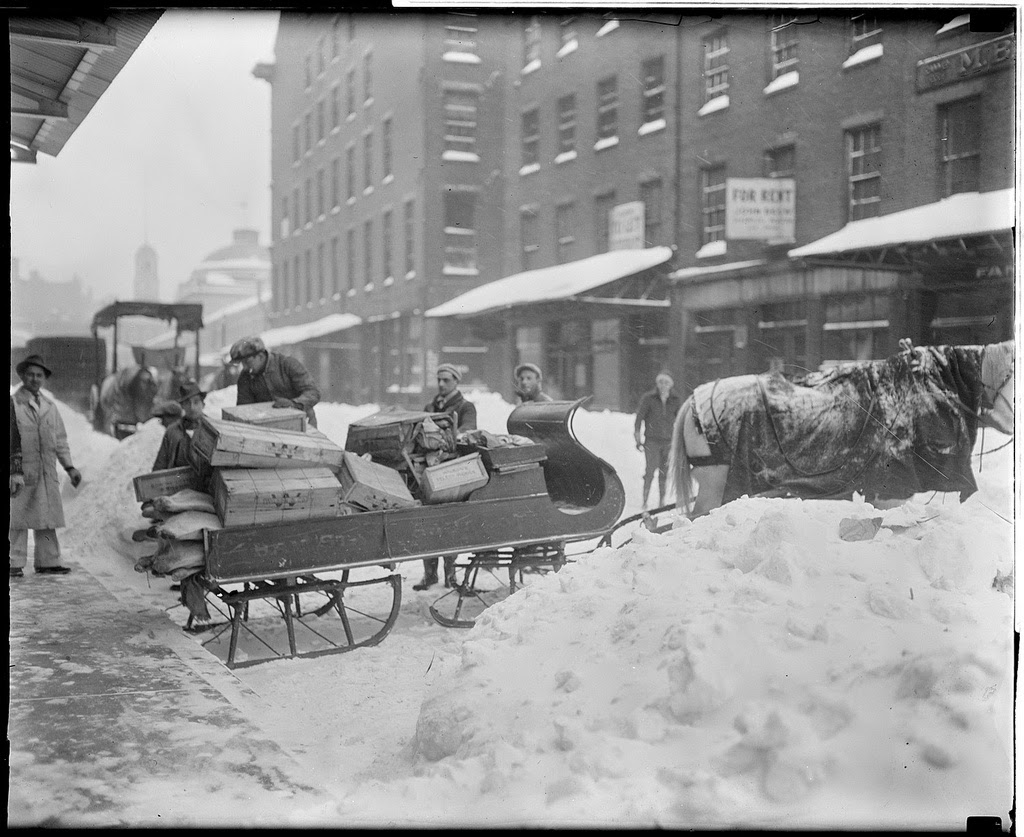
Package delivery by sleigh, market district, date unkown
Girls snowshoeing on Boston Common, c.1930s
Horse slips on snow, c.1920s (poor horse! At least cars don't feel pain when they slide)
Checking the weather equipment on Boston Common, 1923
At the corner of Tremont and Boylston, 1930 (check out those fabulous hats!)
So really, not much has changed!

Carting snow away in trucks, 1939
Snow removal by truck, 2015 (via the Boston Globe)
For those of you in New England, stay warm and safe!

Tuesday, January 27, 2015

The "Winter Princess" 1890s Ballgown

This weekend was the 1890s ball and skating outing with the Commonwealth Vintage Dancers, and I was really pleased to have my friend KP come visit to join me! Of course, that also meant I needed a new dress...

I'd been planning to make a new 1890s dress eventually anyways, because my butterfly dress has a lot of fit issues and I've had it for several years at this point. (Although I will admit the changes I made for a ball this summer--which I've never blogged about, bad blogger! but Quinn has, and it was also covered by Bill Cunningham, so you can spot me in group shots there--greatly improve my feelings about the dress.) Anyways, I'd been planning a new dress...but this ended up being sort of the "murphy's law" of sewing plans: first I had a business trip that put me behind on sewing projects for earlier in the month, then I got horridly ill, and then I was sitting in the ladies' dressing room sewing when I was supposed to be setting up refreshments. Whoops.

I didn't have time to go fabric shopping, so I used a blue velvet I had in my stash originally purchased for the 1870s dress I made at Christmas. It is gorgeous, plush stuff that looks quite bright in some light and quite dark in other light. Like magic! A friend also nabbed me some white rabbit fur trim, which is a fabulous contrast. Right now there's just a bit thrown on, but I have 16 1/2 yards of it, so that's coming! 

I knew I wanted to make a super classic 90s dress with big sleeves, because my butterfly dress doesn't have them. I drew inspiration from portraits of the Russian royal family as well as some of the dresses belonging to Empress Maria Fyodorovna. Here are some favorites:

engagement photo of Nicholas II and Alexandra, 1894: big sleeves, fur trim

portrait of Grand Duchess Elizabeth c.1890: dark with pale trim, lots of pearls
Portrait of Maria Fyodorovna, 1894: fur trim!
Purple velvet dress by House of Worth for Maria Fyodorovna, 1890s

Years ago I purchased 1890s skirt and bodice patterns from Laughing Moon Mercantile, but when I started working on this project I decided I didn't have time to make a toile (as it was already the week of the ball), and I knew the bodice pattern didn't fit me very well straight out of the envelope. Instead, I ended up using the 1875 bodice pattern from the Mother/Daughter Dress Project because I knew it fit well. I switched the closures from front to back, shortened the bodice to end at my natural waist, and raised the neckline up slightly on my shoulders. I did stick with the Laughing Moon 5 gore skirt pattern, but I re-curved the top of the panels to make it fit more snugly on my hips without losing the volume at the hem.

There are still some adjustments to make (a hem, for instance, would be good--this will get a stiff linen interfacing as well as a velvet facing to help keep the shape), but overall I'm happy with this. I definitely felt regal, so mission accomplished!

The 1890s ball was held at the Dane Estate, an absolutely lovely mansion just outside Boston. We had fun posing for pictures in its elegant rooms, but with all the crazy going on I completely forgot my camera. As a result, these were all taken on my phone. Apologies, but enjoy!

playing with the full length mirrors in the library


sitting in the round mezzanine between the first and second floors--sorry these are so grainy! My phone did not like the dark...


my friend in my ballgown. She looked lovely and it was nice to be able to make her feel like a princess.


As people post pictures of the ballroom I'll do another post!

Tuesday, January 20, 2015

Caught On Camera

I'm still recovering from my weekend at Arisia, our local scifi/fantasy convention. I changed costumes 4 times on Saturday! 

In the meantime, the fine folks over at Nerdcaliber covered the event and I wanted to share their images of me. Take a look! 


Image courtesy of Rodney Brown

Image courtesy of Rodney Brown
Check out FirstPerson Shooter's gallery over at Nerdcaliber (linked in the captions) for more images from the convention!

Monday, January 12, 2015

Music of the American Women's Suffrage Movement

In an effort to share the research I did in 2013-2014 and never posted about, some of the posts in the next couple of months will be a little out of order. I hope you enjoy them anyways!

At the America's Hometown Thanksgiving event, we keep warm and engaged by singing suffrage songs. These gave us a great way to engage visitors, share some of the messages from the American women's suffrage movement, and give our rally some spirit. Here's a short video of us singing from the event this year, courtesy of my awesome friend (and fellow suffragist):


Music is often a popular way to disseminate a group's message, so it's no surprise that there were many, many songs written for the suffrage movement (there were also many, many "anti" song written). In fact, the American women's suffrage movement has roots in several other reform movements from the 19th century--the most famous being abolition--which was also known for its music related to the cause. The songs we sang were all to traditional tunes, many of them written during the mid-19th century and related to the civil war.

Sheet music cover for the "Suffrage March Song," from the collection at the Oregon Historical Society
Music was an integral part of suffrage rallies, marches, and gatherings. It was common for events that required a crowd (like speeches) to start with a song; the music would gather the crowd, share the suffrage message, and get listeners warmed up for the following oratory. The publication of music also provided a print avenue to share suffrage ideas with the masses--people who would never read a suffragist publication (like The Suffragist, 1913-1920) might see, or even browse, a suffrage song. The cover illustrations, which often featured the "new woman" as an empowered, wise figure with calls to goddesses in mythology, or holding babies and doing household tasks as their normal lives continued, offered a chance to demonstrate a future with enfranchised women: strong, contributing members of society who were still wives and mothers (not a threat to the very fabric of society, as anti-suffragists argued). Inside, the lyrics provided reasons for women's suffrage, aimed at both women and men--some songs focused on why women should want and have the vote, while others called men to pass suffrage bills (because women, of course, could not vote to do so!).

Sheet music cover from 1920, the year women were finally given the vote
For example, "Marching Together"* is sung from the man's perspective, and entreats:

And let us help her win the fight
She may not win alone
While we go marching together

While a verse in "Song for Equal Suffrage,"** sung from the woman's perspective, explains:

Not for self but larger service has our cry for freedom grown, 
There is crime, disease and warfare in a world of men alone, 
In the name of love we're rising now to serve and save our own, 
        As Peace comes marching on!

and the chorus of "Another Star,"** which is more of a gender-neutral campaign song:

A ballot for the Lady! 
For the Home and for the Baby! 
Come, vote ye for the Lady, 
      The Baby, the Home!

There are some pretty straightforward themes that begin to emerge in these lyrics. Songs from the man's perspective often boil down to "do the right thing," but also point out that denying women the right to vote is denying a basic human right to women in their families (their sisters, mothers, and daughters). Alternatively, many of the songs from the women's perspective focus on the importance of women as moral centers (an argument used during the abolition movement as well), as caretakers, and as equal partners in the home. These lyrics leverage traditional views of women as the "gentler sex" to say that the country needs women's votes to keep peace and improve conditions. They also draw attention to the expectation for women to run the home--if women can handle the complicated socio-economic considerations for managing a household, why aren't they equally enfranchised?
One of my favorite songs that addresses the equal partnership argument is "The New Way"*:

Now the girls, in crimps and curls,
Take up the cue she gave,
And tell their lovers, one and all,
They will not play the slave
To any man whose selfish plan
Makes them but satellites,
For no such things as wedding-rings
Shall rob them of their rights.

Something to note about all of these arguments is that not a single one is pushing to really change the status quo: they aren't arguing women should give up motherhood, or abandon marriage, or join the workforce en mass. They're simply asking to be recognized for the work they are already doing (both in and out of the domestic sphere) and given the right to vote.

suffrage button, 1918
Of course, there were many many other arguments during the hundred years or so of the women's suffrage movement in America. But in particular, the messages set to music were able to reach people who would otherwise never hear them--men and women who would never attend a rally, read a pamphlet or journal, who might otherwise have missed the voices of suffragists altogether. The power of music for the suffrage movement was that it allowed suffragists to reach these audiences, and ultimately, their efforts succeeded.

pro-suffrage poster, c.1910s


The lyrics featured here are from the following collections:
*The Suffrage Song Book, 1909
**Suffrage Songs and Verses, 1911

For more on suffrage music:
"(M)othering: Strategies of Musical Activism in the American Women’s Suffrage Movement, 1900-1920"


Saturday, January 3, 2015

Lessons and Experiments: 2014 in Review

I did my first retrospective post last year, and found that it was an incredibly helpful way to look at how much I'd accomplished (and also how poorly I often manage my time). This year, I wanted to do something similar. As I started to dig through my posts, I realized I had some firsts this year! A new time period (WWII), some new photography techniques (my petzval lens), and a new series of ongoing research posts (my image in context series). There was a ton of research, thousands of photos, and a heap of adventures. That said, there wasn't quite as much sewing! I'm going to take that as a sign that I tried to achieve my new year's resolution not to undertake projects at the very last minute...or at least, not quite as often.

So without further ado, a brief review of 2014!

January


I make a 1920s evening dress for our performance at Arisia
February


I use the same shot fabric for a new Regency ballgown...
...and start my photography research post series
March


Rather than rush a new dress, I fix the fit on my pink plaid 1860s gown from last year
April


I play with different views for photographing events
May


I work with tulle for the first time and make a 1950s party dress
June


I pull and all-nighter (whoops) to whip up a 1910s ballgown for a 1914 performance,
take my first shot at battle photography for a WWII reenactment,
build my first camera mod,
and make an evening bodice for my printed cotton 1860s dress
(whew! June was apparently pretty crazy!)

July


I re-drape the bodice for my 1910s ballgown,
and do my first real photography outing with the petzval
August


I make a new white linen 1920s dress for picnicking
September


We squeeze in a last picnic on Labor Day (and I use it to do some more petzval work),
and I begin the Mother/Daughter Dress Project with my first attempt at plaid matching! (both bodices are constructed)
October


Undergarments elude me, but I bake up a storm
November
I mostly complete the Mother/Daughter Dress Project (with help from Mom!) over Thanksgiving: both skirts and underskirts are completed, and the bodices are wearable
I shoot our suffrage rally for the Plymouth Thanksgiving celebration, aiming to take portraits that capture the feel of the event (you can decide how well I did in my upcoming post on this!),
and disassemble my hobble skirt to make a new skirt I can picket in, and construct a new overskirt for the ensemble


December

I finally complete--and wear!--my dress for the Mother/Daughter Dress Project by finishing my bodice
It turns out 2014 had more than I expected, and I was lucky enough to attend some really wonderful events. As I went through my previous blog posts to put together this retrospective, I noticed a couple of things: for every last-minute project I made this year (or revisited from last year), I ended up doing alterations after the first wearing to fix the mistakes I'd made while rushing through the project, and while I did a lot of research (primarily on female photographers), I never posted it. So even though I made fewer things, I'm happy with my resolution to sew slower. Hopefully I can keep it up in the new year! (And get those research posts up!)

I also have a couple of other resolutions to add to the list: I'd like to make some of the projects I have fabric for, that have been sitting in my stash for years at this point. I'd also like to work on doing some photo shoots outside of events I'm already attending--take an afternoon, get dressed up, and just take photos. It's not normally what I do with my clothes (I mostly sew specifically for events), but I think it would be hugely helpful to practice actually taking pictures.

That second resolution I could use some help with: if you're in the Boston area and you're up for a picture-taking afternoon (historical or otherwise), let me know!

Best wishes for the start of 2015!