Sunday, May 17, 2015

The Modern Home, circa 1960

I've been a terrible blogger lately, because life has been a little crazy. In addition to some family things, I unexpectedly found a new apartment, signed a lease, found a subletter for my current apartment, and moved.

Like I said, it's been a little crazy.

BUT, the new apartment is awesome, and as I've started to unpack I've been reminded of all the plans I had for this summer, and all the projects I wanted to do. (Of course, it's also inspired a lot of new projects, but someday I'll do them all, right?) So when I finally feel settled and am not longer spending my free evenings building furniture, I will be right back to it.
In the meantime, the new apartment has a sweet black and white tiled floor and mirrored closet doors and screams late 50s/early 60s to me.

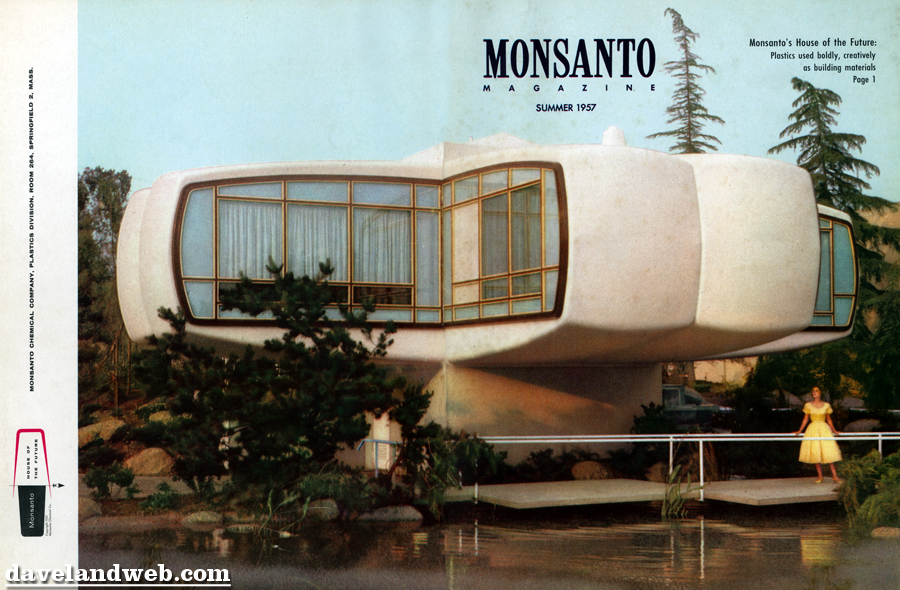
We're not going all-out vintage, but the period style is there in general shapes and colors and it's pretty great so far. So to keep you entertained while I crawl back from blogger limbo, here are some pictures from the opposite direction: the "Monsanto House of the Future," a Disneyland attraction from 1957-1967 that represented what homes in the future (c.1986) would be like.

the House of the Future, exterior
The display was co-sponsored by the Monsanto Company, MIT, and the Disney Imagineering team and featured a house with huge glass windows, a microwave, a large wall-mounted television, adjustable surfaces (the height could change on the kids' sink!), and a whole lot of plastic (including the exterior!). While plastic isn't the building material of choice, a lot of the other features of the house really have made it into everyday life, and the "retromodern" furnishings are making a bit of a comeback. So here's the House of the Future, firmly rooted in the mid-century:

The Monsanto house at night, from Yesterland
the layout
rooms for the kids
the kitchen and parents' bedrooms
the bathroom
the living room

Monday, April 6, 2015

Dances of Vice Presents the Grand Corset Ball

Last weekend some friends and I took an adventure to NYC to perform at the Dances of Vice Grand Corset Ball, which was quite a spectacle and quite a lot of fun!

We decided to wear 1860s fancy dress, so in true period fashion everyone scrounged to create something fabulous on top of dresses we already had. I ended up not getting my act together to do anything truly creative, so I popped a tiara on with my dark blue shot silk and called it "the night sky." Everyone else did an excellent job, though, and we were pretty fabulous as a unit!

fancy dress for the Queen of Clubs, 1860
a much better night sky, 1863
I did get myself organized enough to bring my camera, and I took the opportunity to play with my Petzval lens. It's still difficult to get crisp shots (no autofocus plus a super-heavy lens is a recipe for shaky arms), but I understand why this design was popular for so much of the 19th century--when it works, it's really awesome.

So here are some photos from the Grand Corset Ball!

Julia in fabulous duct tape deer antlers 


Reading--her headpiece is made of quill pens and an inkbottle!
 
an armored corset on display at the event

one of the rooms had a variety of old and new books, so we peaked through a few


these pictures are totally separate, but in this sequence I like to think this lady is witnessing the angel on the stairs!


a flower basket holding her own handels


her rhinestone skull and butterfly headdress was very cool!


I could not get a good shot of this dude from the front, so we must be satisfied with his fabulous hat

I also got a couple of good shots of one of the other performers, who did a medieval-themed burlesque number, but they are pretty NSFW--see them after the jump if you'd like!


Thursday, April 2, 2015

Exciting News and a #ThrowbackThursday Contribution

Those of you who have been around a while know that I love tartan, and that I often look for ways to add tartan into my historical wardrobe. In order to produce historically accurate plaid clothes, I've also ended up doing a lot of research on how tartan (and other plaids) play into fashion trends throughout the 19th and early 20th centuries. I love reading and writing about tartan, and I love sharing it with you!

I'm excited to say that now I'm getting to share all of this crazy plaid love with a whole new audience over at Jezebel/Pictorial! The article itself pulls from some of the posts I've written here, but is updated to reflect the amount I've learned since I started posting about tartan almost two years ago.

Plus, how cool is the illustration the Pictorial team came up with? I love it!
You can check out the article on Pictorial here.

You know I love tartan, but what about you? I'd love to see/hear about your favorite tartans, plaid outfits, or other historical inspirations!

the (Dress Stuart) tartan ballgown that started it all, at Newport in 2012

Monday, March 23, 2015

Mix and Match: My War Correspondent Uniform

It's been a couple of months since my last WWII adventure, but I wanted to share a set of photos to explain what I wear when I'm dressed as a War Correspondent. Consider it the fashion half of my WarCo posts--more on their role in the war coming soon!

War Correspondents are an interesting in-between: civilians in uniform. Many of the women who covered the war from foreign locations were there providing reports long before the USA officially entered the war, so they'd been writing and shooting photos in normal/civilian clothes. It's likely that they continued to do so even after the US was involved, because sometimes there's no time to change--dresses, pajamas, overcoats, you get the story whether you're dressed or not. War Correspondents were also less uniform than actual military women; before real uniforms were available, some WarCos took uniform specifications to have made up at a tailor. In other cases, just like women joining up, they would alter available men's garments because there wasn't anything for the women yet. While the availability of uniforms as the war progressed increased (and therefore it would be easier to have a "real" uniform), I think it's fair to say that WarCos didn't always fit military specs for the branch they were associated with, although they tried their best to match.

Accredited War Correspondents were listed officially as captains (although the rank was purely symbolic), so that in case of enemy capture they had a rank to provide leverage. It also offered protection against accusations of spying. I find this quirk particularly interesting: wearing officer uniforms with correspondent insignia was a protection against being thought a spy. A random civilian wouldn't be outwardly demonstrating their affiliation, which would look more suspicious if the civilian started taking notes, asking questions, or taking pictures--behaviors both spies and reporters might exhibit. For WarCos attached to the US Army (which is what I do, and what I will focus on), this mean wearing two types of insignia: 1) US lapel pins, which were worn as part of the female WAAC uniform, and 2) Correspondent or Photographer arm bands (later patches).

an iconic image of female War Correspondents in London--notice the "C" armbands on their uniforms, and the differences in skirts and shoes

a second, less famous image of the photo above being taken--notice the photographer is wearing a "P" armband. This photo by correspondent David Scherman
Most importantly to me, uniforms provided a professional quality to female War Correspondents that they had been fighting for--and continued to fight for. Uniforms announce "I am a part of this war effort." They make it more difficult (but certainly not impossible) to dismiss the woman wearing it. They are a tangible representation of the important work being done, and I can only imagine how monumental that was.

War Correspondents also had a few differences in their uniforms: sometimes they wore a beret, although women's army uniforms did not include one; sometimes they wore the belt/buckle dropped from the women's army uniforms; they typically wore men's garrison caps instead of Hobby Hats (there was a female version of the garrison cap later, although it appears to have been less commonly acquired for WarCos). There appear to also be several variations of the insignia set, probably more variation than with women's actual army uniforms. Several kinds of WarCo patches, occasional shoulder loops, metal pins instead of patches altogether. There's a range, which is both frustrating (it's hard to decide what to wear to look "right") and flexible.

107 best Women WarCos WWII images on Pinterest | World war ...
Correspondent Helen Kirkpatrick in an army beret with WarCo patch

My War Correspondent uniform comes from several different sources. I'm still working on it--the more you learn--but at the moment I have a base to support excursions in winter and summer, with some layers to change around and keep things interesting. My base outfit is an older (WAAC)-style uniform with jacket and belt, because I wanted to go towards the first uniforms a WarCo would have been able to get. When I first wore it, the pockets and buttons were wrong because there wasn't enough time to fix them before the event. Since then, I've re-done the pockets and switched out the plain gold buttons for original bakelite Army ones (which were later replaced with the more common gold ones). I opted for a matching set of OD (olive drab) skirt and jacket, because that way it's very little effort to switch to WAC if I decide I want to, but I could have opted for the officer "pinks" option (and it seems that many correspondents did wear that version).
My first event as a WarCo, wearing my uniform (and carrying my camera)
A quick cell phone snap of the re-done uniform jacket with new buttons/pockets, because of COURSE there isn't a single picture of me wearing it at the event in January :)
It's worth noting that I prefer the beret to the garrison cap, although I do have one as well because options are great! (and you can do more fun hair with the garrison cap...) It's also worth noting that my current beret is black, but I've recently learned that it should actually be khaki--the more you know--so I'll be fixing that before my next event. It's a process! In addition to some form of hat with WarCo patch, I also wear a patch on my jacket (you can see it in the photo above) and a "C" armband (which I don't have a picture of, because I'm the one behind the camera). Although as a photographer I could (and probably will at some point) wear a "P" instead, early on the only armbands were the "C" for "correspondent" and that's generally what I'm aiming for.

My shoes are also close but not perfectly army-issue. In the picture above from this summer I'm wearing modern gray Aerosole heels, which are pretty similar to original 40s shoes I've seen. Actually, I ran into a girl at the WWII weekend in June who was amused we had the same original 1940s shoes--except hers were originals, and mine were the modern Aerosoles! Since then, I've gotten a pair that are better with a uniform, since they more closely resemble the brown WAC oxfords. You can see that second pair in the pictures below: black oxfords with a low heel, from Payless's "comfort plus" (aka faux Aerosole) line. They're perfect, because they look close enough (which is what a WarCo would have aimed for) and they're super comfy. They're also pretty waterproof, which came in handy in the snow!
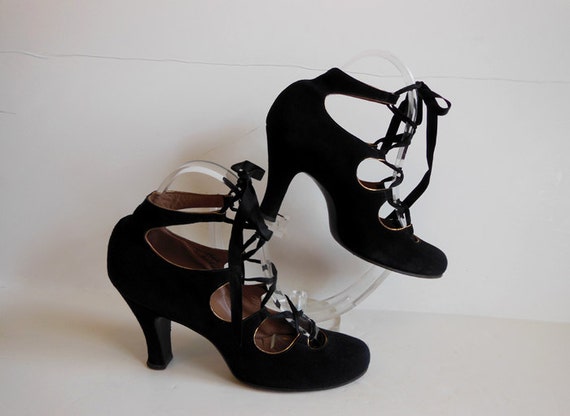
my gray shoes are a little like these originals, currently for sale on etsy
For the Fort Indiantown Gap event I attended in January, I also needed some warm layers. It was super cold, and I was so glad I had them! To add to my jacket/skirt base, I decided a second layering option would come in handy. That ended up being an OD shawl-collar sweater, which is a reproduction of a men's army piece. It wasn't uncommon for women to have to make do with leftovers from men's uniforms at the beginning, and being warm would be more important than having a great fit, so I decided it was reasonable to imagine a female WarCo in a men's army-issue sweater. Plus, it was 100% wool and so warm. 

original photo of WACs off duty--you can see the different layers and sweaters here

hanging out with friends in my sweater
On top of my uniform, I also needed a coat. I've been keeping an eye on ebay for a WAC overcoat, but they're kind of hard to find and usually pretty expensive. In the meantime, I've done what an actual WarCo would have: acquired a men's army overcoat instead. I wore mine with the "C" armband, since I didn't have a correspondent patch for it. It was long and not very flattering, but totally worth it. Frostbite is no fun! Of course, I've managed to not get a picture of that either. I need to do better next time with this!

While at the event, I also picked up a WAC parka. These seem to be particularly rare, and are OD with brown "fur" of some kind (alpaca fleece, if my research is correct) lining it and forming the collar. It isn't in the best shape, but was amazingly warm and I'm going to try to preserve it. I've actually had a really hard time tracking down information about this particular item, but did find it mentioned in World War II Allied Nursing Services, which includes the following passage labeled 1943:
"One example of this [ANC/WAC uniform] co-ordination was the cold weather parka; the issued item was identical for both services...The parka had a warm alpaca fleece lining with a windproof cotton shell, a detachable hood and waistbelt. Under field conditions complaints were received about the fastening--a five-button front with a storm flap secured by three press studs" (p.1955).

in my parka in the bitter cold in January--this is missing the belt, but does have belt loops, so I stole the belt from my uniform jacket eventually

All in all, I've got a lot of options to mix and match while still in uniform, and that's pretty awesome. Even better, when I'm in uniform at an event trying to take pictures, people just assume I'm official, so I get to take pictures from areas the attending public isn't allowed to go near. It's not nearly the same as the struggle correspondents faced to get the best shot of the action, but it's about as close as I can get to understanding the triumph that goes along with that perfect capture.

To learn more:
Smith, Jill Halcomb (2004). Dressed for Duty (vol 2). R. James Bender Publishing: San Jose, CA.  
Sorel, Nancy Caldwell (1999). Women Who Wrote the War. Harper Collins: New York, NY.

Friday, February 20, 2015

Liberating My Legs: A Re-made Plaid 1914 Skirt

In November 2013, I participated in the America's Hometown Thanksgiving living history event for the first time as a women's suffragist. Since the only 19teens clothes I had up until then were evening dresses, this also meant making a new ensemble. I'll be honest: ragtime styles have never particularly called to me, so I decided that if I was going to put in the time/effort to make a 1914 outfit, I wanted to make something a little crazy and very fashionable for the early 1910s. After some poking about, I settled on making a "hobble skirt"--a skirt that narrows perceptibly at the knee, with such a narrow hem it actually interferes with taking a full stride.

A fashionable ensemble with the narrowed "hobble" hem, 1913
Hobble skirts were all the rage, but they were so dumb. There are newspaper articles from the period (you can read examples here and here) discussing the difficulties for walking, getting into and out of cars or trams, and generally functioning in these. Naturally, I thought they were hilarious and I wanted one. (Not to mention, I figured they'd be easy to do and I needed a quick project).

In Plymouth, 2013
So I did make a hobble skirt, and it came out pretty well! But it was super dumb, and I spent all day getting laughed at (good natured-ly by my friends, and not so kindly by some of the other participants).

you can see the very narrow hem here
It frustrated me. So this past November, when I started planning for our suffrage rally round 2, I knew I wanted to widen out my hobble. Because not only was it frustrating and super dumb to wear, it also made me realize that the hobble skirt represented the exact attitude suffragists were fighting.

A cartoon mocking women trying to move quickly in hobble skirts

Postcard of a girl in a hobble skirt pointing to her feet and saying "I can't kick!"
There seems to be an attitude in articles about the fad of "stupid women, wearing clothes they can't move in." There was even a movie from the period called The Suffragettes and the Hobble Skirt (1910), which seems to not exist anymore, but the plot of which is described as "a persecuted man gives women hobble skirts and they are jailed." Essentially, the hobble skirt fashion is used as women's own downfall from their fight for the vote (source on the film here). 
I'm not trying to argue that women who were suffragists did not ever participate in popular fashions, or that a suffragist would never wear a hobble skirt. It's absolutely possible--believing women should have the right to vote doesn't mean you can't also like dumb things. (I certainly believe in both women's rights and dumb fashions.) But I do think that when we, as living history presenters, wear historical clothes at events, we might be the only exposure some people have to the period--and that is worth keeping in mind when planning ensembles. That first year, wearing the hobble skirt, I encountered a lot of the same attitudes from other people at the event that I encountered in texts from the 19teens.

And that definitely wasn't the impression of the women's suffrage movement I wanted to present. 

So the night before our second round of rallies I set to work (I know, I know...last minute...). The first step was to release the pleats from the original skirt, to give my self full range of motion. It's still narrow, in keeping with the 1914 silhouette, but with enough room to function. Next I used the leftover fabric from the stash (thank goodness for buying too much!) to create an over-layer, which made the now very boring skirt tube look way more interesting.
I took inspiration from the layered skirts in fashion plates like these:
dresses, 1914
ensembles with tiered skirts, 1914
my favorite (of course): plaid tunic skirt
I ended up with something I am much, much happier with.

I ended up ditching the original jacket I made--maybe by next year I'll have fixed that too...
I think in the end the over-layer is too long (it was supposed to be sorter, but it kept sliding down my hips), but aside from that I'm really satisfied with this. The plaid wool is warm, the shape is fun and stylish, but most of all--it's functional. I did just fine climbing around all day in 20 degree weather (well, I could move...I was pretty cold!), and I didn't feel super dumb. Hooray!

I also love the way it moves in the wind

And I do mean this is functional, even though it still keeps the narrow look. I even went ice skating in it as part of our 1890s weekend in January! (Also, since we were ice skating, these are all cell phone pics...sorry!)

on the ice

oh hey! range of motion! (and closed eyes...whoops.)


In the end, I'm happy with this project--and I'm excited to wear it again as we rally!