I don't know why, but "gaggle" just seems like the right term for people in 1830s clothes!
Through a mix of intention and serendipity, I wasn't alone on my 1830s adventure for Fezziwig's this year. A bunch of us ended up taking a break during the same dance to take pictures, so with help from an obliging gentleman we captured to shots of a bunch of 1830s ladies. I think what I love most about these images is how complimentary our ensembles are while all being totally unique to our personal styles.
So there you have it! I'll be away over the holidays for the first time, so things will be a bit quiet here until the new year. So have a very happy holiday season, and best wishes for 2017!
Showing posts with label holidays. Show all posts
Thursday, December 22, 2016
Thursday, December 15, 2016
Put a Bird On It
I've previously posted about the inspiration and construction of this dress, so all that's left to say is that I was quite pleased with my decision to use tulle as the sheer over-layer. It had an airy, invisible quality that made me feel like a Christmas tree topper.
![]() |
| basically the only picture that shows the vertical pleating on the bodice |
![]() |
| the belt buckle I polished was a perfect touch! |
And then of course there was my hair, which was the bird on top of the tree. (maybe? no? not as good as icing on the cake, fine.)
The braid wreath is made of jewelry wire with fake hair hot-glued to it, then decorated with gold and red holly berries from the Christmas clearance bin at JoAnn's. It's pinned in and surrounded by my actual hair, which is curly so it's easy to blend. My plan had been to have a vertical loop in addition to the braid, like this fashion plate. After a collapse into a gluey, plastic-hair mess, the plan had to change. But I think the addition of the decorations make up for it, and maybe I'll try loops again for next time!
The side curls are bangs that I curled based on the Laced Angel's Romantic hair. They worked really well, because they saved my hair for anchoring the giant braid. The bird was a last-minute addition after a friend decided she didn't need it. It was the perfect touch!
I'd love to wear this again for a photo shoot, because I was so busy running around setting up/hosting the ball that I manage to look a bit rumpled in every picture...not to mention all my photos came out weirdly noisy. Harumph. But I was so happy wearing this dress, it doesn't much matter. I look forward to styling this dress in new and different ways (a tartan sash must happen, of course!) in the future.
Oh--and Mom's dress came out great too! She looked awesome.
![]() |
| I don't remember what was said but there isn't a single picture in which I'm not laughing... |
Saturday, January 3, 2015
Lessons and Experiments: 2014 in Review
I did my first retrospective post last year, and found that it was an incredibly helpful way to look at how much I'd accomplished (and also how poorly I often manage my time). This year, I wanted to do something similar. As I started to dig through my posts, I realized I had some firsts this year! A new time period (WWII), some new photography techniques (my petzval lens), and a new series of ongoing research posts (my image in context series). There was a ton of research, thousands of photos, and a heap of adventures. That said, there wasn't quite as much sewing! I'm going to take that as a sign that I tried to achieve my new year's resolution not to undertake projects at the very last minute...or at least, not quite as often.
So without further ado, a brief review of 2014!
January
February
March
April
May
June
(whew! June was apparently pretty crazy!)
July
August
September
October
November
December
It turns out 2014 had more than I expected, and I was lucky enough to attend some really wonderful events. As I went through my previous blog posts to put together this retrospective, I noticed a couple of things: for every last-minute project I made this year (or revisited from last year), I ended up doing alterations after the first wearing to fix the mistakes I'd made while rushing through the project, and while I did a lot of research (primarily on female photographers), I never posted it. So even though I made fewer things, I'm happy with my resolution to sew slower. Hopefully I can keep it up in the new year! (And get those research posts up!)
I also have a couple of other resolutions to add to the list: I'd like to make some of the projects I have fabric for, that have been sitting in my stash for years at this point. I'd also like to work on doing some photo shoots outside of events I'm already attending--take an afternoon, get dressed up, and just take photos. It's not normally what I do with my clothes (I mostly sew specifically for events), but I think it would be hugely helpful to practice actually taking pictures.
That second resolution I could use some help with: if you're in the Boston area and you're up for a picture-taking afternoon (historical or otherwise), let me know!
So without further ado, a brief review of 2014!
January
![]() |
| I make a 1920s evening dress for our performance at Arisia |
| I use the same shot fabric for a new Regency ballgown... |
| ...and start my photography research post series |
![]() |
| Rather than rush a new dress, I fix the fit on my pink plaid 1860s gown from last year |
![]() |
| I play with different views for photographing events |
![]() |
| I work with tulle for the first time and make a 1950s party dress |
![]() |
| I pull and all-nighter (whoops) to whip up a 1910s ballgown for a 1914 performance, |
![]() |
| take my first shot at battle photography for a WWII reenactment, |
| build my first camera mod, |
![]() |
| and make an evening bodice for my printed cotton 1860s dress |
July
![]() |
| I re-drape the bodice for my 1910s ballgown, |
![]() |
| and do my first real photography outing with the petzval |
![]() |
| I make a new white linen 1920s dress for picnicking |
![]() |
| We squeeze in a last picnic on Labor Day (and I use it to do some more petzval work), |
| and I begin the Mother/Daughter Dress Project with my first attempt at plaid matching! (both bodices are constructed) |
![]() |
| Undergarments elude me, but I bake up a storm |
![]() |
| I mostly complete the Mother/Daughter Dress Project (with help from Mom!) over Thanksgiving: both skirts and underskirts are completed, and the bodices are wearable |
![]() |
| I shoot our suffrage rally for the Plymouth Thanksgiving celebration, aiming to take portraits that capture the feel of the event (you can decide how well I did in my upcoming post on this!), |
![]() |
| and disassemble my hobble skirt to make a new skirt I can picket in, and construct a new overskirt for the ensemble |
December
![]() |
| I finally complete--and wear!--my dress for the Mother/Daughter Dress Project by finishing my bodice |
I also have a couple of other resolutions to add to the list: I'd like to make some of the projects I have fabric for, that have been sitting in my stash for years at this point. I'd also like to work on doing some photo shoots outside of events I'm already attending--take an afternoon, get dressed up, and just take photos. It's not normally what I do with my clothes (I mostly sew specifically for events), but I think it would be hugely helpful to practice actually taking pictures.
That second resolution I could use some help with: if you're in the Boston area and you're up for a picture-taking afternoon (historical or otherwise), let me know!
| Best wishes for the start of 2015! |
Wednesday, December 31, 2014
The Pudding Acheivement
For the last couple of years, my contributions to the Fezziwig's Ball refreshments table has been figgy pudding. Fezziwig's Christmas party is described in A Christmas Carol:
"There were more dances, and there were forfeits, and more dances, and there was cake, and there was negus, and there was a great piece of Cold Roast, and there was a great piece of Cold Boiled, and there were mince-pies, and plenty of beer. But the great effect of the evening came after the Roast and Boiled, when the fiddler (an artful dog, mind! The sort of man who knew his business better than you or I could have told it him!) struck up “Sir Roger de Coverley.” Then old Fezziwig stood out to dance with Mrs. Fezziwig. Top couple, too; with a good stiff piece of work cut out for them; three or four and twenty pair of partners; people who were not to be trifled with; people who would dance, and had no notion of walking."
Figgy pudding only plays a tangential role in the festivities, but it is central to the celebration at Bob Cratchit's house. As Scrooge observes,
"In half a minute Mrs. Cratchit entered—flushed, but smiling proudly—with the pudding, like a speckled cannon-ball, so hard and firm, blazing in half of half-a-quartern of ignited brandy, and bedight with Christmas holly stuck into the top."
And of course, figgy pudding is the dessert called for in the carol "We Wish You a Merry Christmas." We sing carols before the ball (including this one), so it seemed doubly appropriate to have some on offer. It also turns out figgy pudding is pretty delicious!
Mentions of figgy pudding (also known as plum pudding, among other names, which is how it appears in A Christmas Carol) have appeared since the 15th century. It was especially popular in America during the 19th century. Dozens of recipes and interpretations were published in magazines and books throughout the century--I particularly love the article "Plum Pudding: A Christmas Essay" published in The National Magazine in 1857:
"But it is not as a work of art alone that I wish to contemplate a plum pudding. I claim for my theme a higher purpose than the mere gratification of the appetite and propose to treat it not only in a gastronomical, but also in national, commercial, geographical, statistical, social, and moral sense. ...Can there be a more thorough embodiment of sociality and good fellowship? Whoever heard of low spirits and plum pudding? or ill temper and plum pudding? or any thing else in connection with plum pudding but hearty goodwill and kind feeling?"
While it's full of dried fruit (not just figs!) held together by breadcrumbs and fat (suet, traditionally), figgy pudding ends up being fairly cakelike. As Mrs. Cratchit "had her doubts about the quantity of flour," this cakelike consistency is pretty accurate for the mid-19th century. The major difference between figgy pudding and desserts we're more used to is that figgy pudding is boiled. It's also traditionally set aflame (or rather, the pudding is covered in a hard sauce which burns off)--something I have yet to try. Instead, I serve our pudding with custard sauce, which is slightly less accurate but entirely delicious.
While it takes me most of a day to make the quadruple batch required for the ball, a single figgy pudding is easy to put together and offers a variety of serving options (although my favorite is a tiny piece of pudding drowned in a big bowl of custard sauce. I am definitely pro custard sauce). Although it's a little late for a Christmas pudding, here is my recipe! I've adapted it from this original (which is also where my custard sauce comes from), with changes to make it more period. The one modern concession I make is that I bake the pudding in a water bath rather than boil it. That way I can get multiples cooked at the same time, and it seems to work just fine. Someday I do need to boil and set one on fire though!
This recipe makes one figgy pudding, which I recommend baking in a bundt pan for ease. If you want the traditional round look, go for an oven-safe bowl (I use a 2-liter mixing bowl/pitcher like this one).
"If I could work my will,” said Scrooge indignantly, “every idiot who goes about with ‘Merry Christmas’ on his lips, should be boiled with his own pudding, and buried with a stake of holly through his heart. He should!”
You can read more about figgy pudding here:
NPR's All Things Considered
The History Channel's Hungry History
The University of Maine's KHRONIKOS blog
"There were more dances, and there were forfeits, and more dances, and there was cake, and there was negus, and there was a great piece of Cold Roast, and there was a great piece of Cold Boiled, and there were mince-pies, and plenty of beer. But the great effect of the evening came after the Roast and Boiled, when the fiddler (an artful dog, mind! The sort of man who knew his business better than you or I could have told it him!) struck up “Sir Roger de Coverley.” Then old Fezziwig stood out to dance with Mrs. Fezziwig. Top couple, too; with a good stiff piece of work cut out for them; three or four and twenty pair of partners; people who were not to be trifled with; people who would dance, and had no notion of walking."
Figgy pudding only plays a tangential role in the festivities, but it is central to the celebration at Bob Cratchit's house. As Scrooge observes,
"In half a minute Mrs. Cratchit entered—flushed, but smiling proudly—with the pudding, like a speckled cannon-ball, so hard and firm, blazing in half of half-a-quartern of ignited brandy, and bedight with Christmas holly stuck into the top."
And of course, figgy pudding is the dessert called for in the carol "We Wish You a Merry Christmas." We sing carols before the ball (including this one), so it seemed doubly appropriate to have some on offer. It also turns out figgy pudding is pretty delicious!
![]() |
| Yum! |
"But it is not as a work of art alone that I wish to contemplate a plum pudding. I claim for my theme a higher purpose than the mere gratification of the appetite and propose to treat it not only in a gastronomical, but also in national, commercial, geographical, statistical, social, and moral sense. ...Can there be a more thorough embodiment of sociality and good fellowship? Whoever heard of low spirits and plum pudding? or ill temper and plum pudding? or any thing else in connection with plum pudding but hearty goodwill and kind feeling?"
![]() |
| The pudding itself, topped with a sprig of holly, pine and berries I bought at JoAnn's a couple of years ago |
While it takes me most of a day to make the quadruple batch required for the ball, a single figgy pudding is easy to put together and offers a variety of serving options (although my favorite is a tiny piece of pudding drowned in a big bowl of custard sauce. I am definitely pro custard sauce). Although it's a little late for a Christmas pudding, here is my recipe! I've adapted it from this original (which is also where my custard sauce comes from), with changes to make it more period. The one modern concession I make is that I bake the pudding in a water bath rather than boil it. That way I can get multiples cooked at the same time, and it seems to work just fine. Someday I do need to boil and set one on fire though!
This recipe makes one figgy pudding, which I recommend baking in a bundt pan for ease. If you want the traditional round look, go for an oven-safe bowl (I use a 2-liter mixing bowl/pitcher like this one).
Figgy Pudding
1lb dried mission figs (the black ones)
1/2lb pitted dried plums (not labeled as prunes, and a little moister)
3/4 c. whole milk
1/3 c. brandy*
3 eggs
1/2 c. butter (melted)
1 1/2 c. all-purpose flour
1 c. granulated sugar
2 tbs. baking powder
2 tsp. ground cinnamon*
1 tsp. allspice*
1/2 tsp. nutmeg*
1 tsp. salt
1 tbs. orange zest (if you're using fresh zest, you could also use lemon or a mix)
1 1/2 c. breadcrumbs
1 c. chopped walnuts
Preheat oven to 350F.
1. In a medium pot, combine chopped figs, plums, milk, orange zest, and brandy. Cook over medium-high heat until milk is bubbling but NOT boiling, then reduce temperature to medium/medium-low, cover, and simmer for 10 minutes. Cool to room temperature.
2. Combine melted butter and eggs (adding one at a time) in a large mixing bowl**. When combined, add breadcrumbs.
3. Add fruit/liquid mixture from the stove and stir until just combined.
[3a. Depending on how much liquid was absorbed by the fruit, the batter may be extremely dry. If needed, add extra milk in small increments alternating with dry ingredients so that final batter is a very thick, but still batter-like, consistency. Be careful not to make it too wet! If the flour is adding in just fine, don't add any extra milk.]
4. Add remaining dry ingredients.
5. Fold in nuts.
6. Pour batter into greased bundt pan or pudding mold. Place pan in a water bath so that the bottom 1/2-2/3 is submerged.
7. Bake for approximately 1.5-2 hours. Begin checking after the first hour, as the shape of your baking device can change the baking time a lot. A knife should come out cleanly, even if the inside is still quite soft.
8. Let stand in pan for 15 minutes, then flip onto cooling rack. Cool completely before slicing to prevent crumbling.
*Feel free to add to taste. Caveat: if not measuring make sure to stay true to the proportions!
**I make this recipe by hand using a spatula to mix.
*Feel free to add to taste. Caveat: if not measuring make sure to stay true to the proportions!
**I make this recipe by hand using a spatula to mix.
![]() |
| Garnishing the pudding with holly |
Enjoy! I ended up with a lot of leftover pudding from the ball, so I crumbled it up and threw it in a casserole dish to turn into bread pudding--pudding squared?--to give the leftovers some new life. The possibilities are endless!
So I will leave you with one last Dickens quote--a final possibility for figgy pudding: murder weapon.
You can read more about figgy pudding here:
NPR's All Things Considered
The History Channel's Hungry History
The University of Maine's KHRONIKOS blog
Wednesday, September 17, 2014
The Mother/Daughter Dress Project (or, the most lead time on a project I have given myself in years because my mother is better at planning than I am)
Earlier this week I posted about plaid matching (or not!) in extant garments, and I mentioned that I am currently working on a project that relates. So far my plaids look pretty good (the shoulders, which will be unfortunately lost in the neck facing/trim and sleeve are my favorite), but not perfect, which seems just about right. I'm taking a pause because I need a new corset, and I don't want to take darts over my old one (which has never fit correctly, even though I made it almost three years ago...whoops). I'm also waiting because this is a special project: I am not venturing into a new decade alone, but rather in a joint expedition with my mother, so I'm waiting until our next sewing date to start the next bit.
My earliest experiences with sewing all involve my mom, who made my Halloween costumes every year until I was too cool for it because I wanted to be a "girl from the Civil War" with a dress out of one of those cheesy catalogs (funny how the 1860s stuck and the store-bought outfits didn't! Clearly Mom's influence was in there...). She would insist that she was only ever an "ok" seamstress, but Mom taught me to use a sewing machine, to pick out patterns and follow pattern instructions, and that sometimes making things was just better (those Halloween costumes were killer).
Last year my family came to Fezziwig's Ball, hosted by the Commonwealth Vintage Dancers, because we all love Christmas and singing carols and having a lot of holiday cheer. I loaned everyone dresses, which worked out fine, but Mom decided for this year she wanted her own dress.
I completely used the opportunity as an excuse to make a dress from a period I wouldn't otherwise have an excuse to sew--I proposed either the 1830s or the 1870s, and Mom chose the '70s. We're aiming for mid-lateish in the decade (with slightly padded butts but still in the natural form era), in between bustle eras. I am also taking the opportunity to make a day bodice and a train extension (I don't want a train at the ball) so that I can wear the dress for swanning around museums or something (for some reason natural form 1870s dresses say "swanning around museums" to me).
Mom and I are both using the same base pattern for a bodice, but taking it in different directions. We also have very different fabric, so the dresses won't look "matchy-matchy" even though we're using the same pattern (TV416).
The natural form era/mid 70s is interesting, because while it's missing the back end accentuation of the two bustle period it's sandwiched between, but it still follows a lot of the same lines (overskirts drawn up at the back, bows and gathers over the butt) and mixes the hard suiting/tailored elements that were coming into style with frilly details (layers and layers of ruffles, trim, and bows).
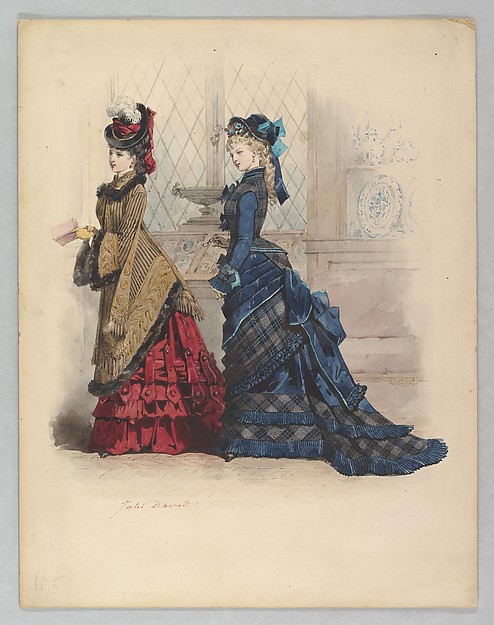
Plaid shows up quite a bit in fashion plates from this period, most commonly in bodices and as trim on skirts (usually bias cut). Another common plaid element is a plaid (sometimes bias, sometimes not) overskirt, often paired with plaid trim on other pieces of the ensemble.
Here are some of my major inspirations; they're almost all day dresses, because I'm planning on this being mostly a day ensemble, since we don't do any 1870s balls besides Fezziwig's (and 70s are sort of late for that).
And here's a preview of my progress!
My earliest experiences with sewing all involve my mom, who made my Halloween costumes every year until I was too cool for it because I wanted to be a "girl from the Civil War" with a dress out of one of those cheesy catalogs (funny how the 1860s stuck and the store-bought outfits didn't! Clearly Mom's influence was in there...). She would insist that she was only ever an "ok" seamstress, but Mom taught me to use a sewing machine, to pick out patterns and follow pattern instructions, and that sometimes making things was just better (those Halloween costumes were killer).
![]() |
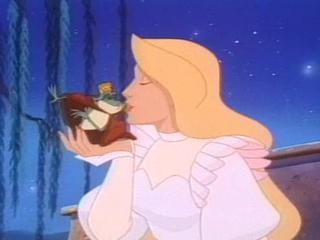
| My first grade class Halloween party, dresses as Odette from The Swan Princess (my absolute favorite movie at the time) in her wedding dress, made by Mom...check out my opalescent swan "wings"! |
| the inspiration (ending scene from The Swan Princess) |
![]() |
| At the ball last December |
Mom and I are both using the same base pattern for a bodice, but taking it in different directions. We also have very different fabric, so the dresses won't look "matchy-matchy" even though we're using the same pattern (TV416).
The natural form era/mid 70s is interesting, because while it's missing the back end accentuation of the two bustle period it's sandwiched between, but it still follows a lot of the same lines (overskirts drawn up at the back, bows and gathers over the butt) and mixes the hard suiting/tailored elements that were coming into style with frilly details (layers and layers of ruffles, trim, and bows).
Plaid shows up quite a bit in fashion plates from this period, most commonly in bodices and as trim on skirts (usually bias cut). Another common plaid element is a plaid (sometimes bias, sometimes not) overskirt, often paired with plaid trim on other pieces of the ensemble.
Here are some of my major inspirations; they're almost all day dresses, because I'm planning on this being mostly a day ensemble, since we don't do any 1870s balls besides Fezziwig's (and 70s are sort of late for that).
| no plaid trim on this one, but a plaid bodice and overskirt. I particularly like the pleated trim on the lower edge of the bodice |
| the complete opposite bodice arrangement from the previous! I like the two shapes of bias-cut plaid edging on the skirts |
| Possibly my favorite of all! Love the double row of bias trim paired with the half-plaid straight cut overskirt |
| Two words on this one: BUTT. BOW. |
| I'm definitely pulling from the barely-there sleeves on these two for my evening bodice |
| my plaid ball bodice from the back...you can see what I mean by "almost" on the plaid matching...(also sorry for the awkward mirror/cell phone pic!) |
| you probably won't see much (if any) of the shoulder when the bodice is done, but these make me happy anyways |
Monday, April 15, 2013
Inner Monologue: A Love Letter to New England
EDT: I wrote this post a couple of weeks ago, and had it all ready to go for today when I got back from the Regency Weekend. Then the bombings in Copley Square happened. I debated posting this at all, but when you come down to it, I almost feel like I need to post it more. Later this week the blog will be back to normal with tons of Regency Weekend shenanigans, so stay tuned. My thoughts are with the families affected by today's events.
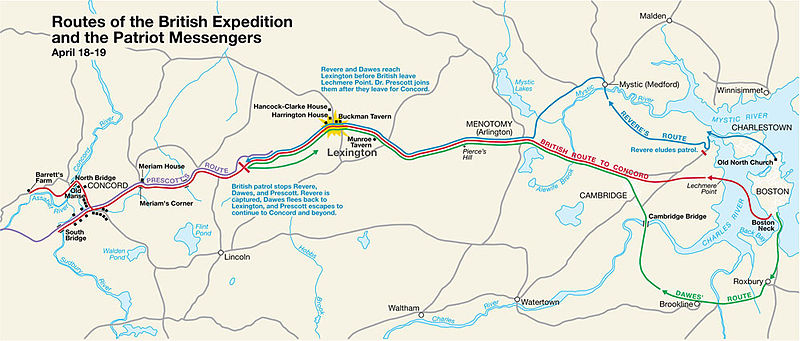
Very early in the morning of April 19th, 1775 the King's militia opened fire on a group of assembled farmers on the Lexington town common, who were trying to stop the troops from completing their intended arrests of rebel organizers Samuel Adams and John Hancock and raid on Concord munition supplies. The troops continued on to Concord, where they were met with a larger, more organized rebel force of militia from surrounding towns prepared to stop their search for the munitions stores. The colonial units and the King's army battled on the North Bridge, over the Concord River. The day marked the start of the American Revolution.
Today (the Monday closest to April 19th), residents of Massachusetts (and some other parts of New England) remember our ties to the founding of the nation by celebrating Patriots' Day. This isn't a new tradition--in fact, perhaps the most famous part of the conflicts was immortalized (however romantically rather than accurately) by Henry Wadsworth Longfellow in his poem Paul Revere's Ride. I remember having the poem read to my third grade class by a man dressed as a member of the Lexington militia and talking to us about the revolution, and going to see the reenactments and parades (when I wasn't marching!).
The poem, as you probably know, begins:
Spirit, that made those heroes dare
To die, and leave their children free,
Bid Time and Nature gently spare
The shaft we raise to them and thee.
Very early in the morning of April 19th, 1775 the King's militia opened fire on a group of assembled farmers on the Lexington town common, who were trying to stop the troops from completing their intended arrests of rebel organizers Samuel Adams and John Hancock and raid on Concord munition supplies. The troops continued on to Concord, where they were met with a larger, more organized rebel force of militia from surrounding towns prepared to stop their search for the munitions stores. The colonial units and the King's army battled on the North Bridge, over the Concord River. The day marked the start of the American Revolution.
| National Park Service map of troop movements to Lexington and Concord |
![]() |
| Battle of Lexington, engraving by Amos Doolittle (1775) |
| Reenactors marching in the Lexington Patriots' Day Parade, from here |
The poem, as you probably know, begins:
Listen my children and you shall hear
Of the midnight ride of Paul Revere,
On the eighteenth of April, in Seventy-five;
Hardly a man is now alive
Who remembers that famous day and year.
Of the midnight ride of Paul Revere,
On the eighteenth of April, in Seventy-five;
Hardly a man is now alive
Who remembers that famous day and year.
and continues on to describe Revere's journey, as romanticized in that charmingly inaccurate 19th century way. Longfellow concludes:
You know the rest. In the books you have read
How the British Regulars fired and fled,—
How the farmers gave them ball for ball,
From behind each fence and farmyard wall,
Chasing the redcoats down the lane,
Then crossing the fields to emerge again
Under the trees at the turn of the road,
And only pausing to fire and load.
So through the night rode Paul Revere;
And so through the night went his cry of alarm
To every Middlesex village and farm,—
A cry of defiance, and not of fear,
A voice in the darkness, a knock at the door,
And a word that shall echo for evermore!
For, borne on the night-wind of the Past,
Through all our history, to the last,
In the hour of darkness and peril and need,
The people will waken and listen to hear
The hurrying hoof-beats of that steed,
And the midnight message of Paul Revere.
Even though this isn't exactly what happened, it's the theme that we remember and celebrate. We remember the idealism and bravery of the colonists who supported a rebellion against King George because they believed in a better world (although I admit that is an oversimplification).
| spring pussy willows near my parents' house |
Patriots' Day has long been one of my favorite holidays, because it is a celebration of Boston's heritage and one of the special times of year when everybody else gets excited about history too. (Or I like to think so...even though I know most people are actually excited about the Boston Marathon.) It is very difficult to go anywhere in MA without seeing signs of New England's age, even if they don't register. Stone walls instead of fences, "cowpath" narrow, windy, practically-circular streets, the normality of costumed tour guides and park service rangers chilling downtown, the plaques on houses signifying their historic status, the cobblestones, the "blue laws"...I'll stop.
| Pioneer Village: 1630, Salem |
What I mean is that history is a part of the lifeblood of Boston (and New England in general) in a different way than in other regions of the country that I've been to. There is something so special about being able to go on a ridiculous bar crawl and be on a walking tour of the city at the same time, because the men who founded our country discussed their plans for a democracy over drinks in the same taverns. This probably also has to do with the fact that there are often people in 18th century attire hanging out when I've been in--and that's perhaps my favorite thing about Boston. We've embraced our history, we celebrate it, and bringing it to life is just another part of the scenery. I love being a part of that.
| waving to a Swan Boat full of drag queens in the Boston Public Gardens. Nope, not even joking a little. |
While I've loved living other places Boston will always have my heart, and its blatant expression of "history worship" (as Barbara so aptly put it) is a large part of that. The city is built on the strength of its community and the heights of its ideals, and maintained by the stubborn fortitude it takes to stick out a New England winter. Patriots' Day is a celebration of that to me.
Happy Patriots' Day, with love.
| The Old State House, from the BU website |
And because I love that 19th century romanticism, I'll leave you with Emerson's Concord Hymn, which sort of sums it up:
By the rude bridge that arched the flood,
Their flag to April's breeze unfurled,
Here once the embattled farmers stood,
And fired the shot heard round the world.
The foe long since in silence slept;
Alike the conqueror silent sleeps;
And Time the ruined bridge has swept
Down the dark stream which seaward creeps.
Their flag to April's breeze unfurled,
Here once the embattled farmers stood,
And fired the shot heard round the world.
The foe long since in silence slept;
Alike the conqueror silent sleeps;
And Time the ruined bridge has swept
Down the dark stream which seaward creeps.
On this green bank, by this soft stream,
We set to-day a votive stone;
That memory may their deed redeem,
When, like our sires, our sons are gone.
We set to-day a votive stone;
That memory may their deed redeem,
When, like our sires, our sons are gone.
Spirit, that made those heroes dare
To die, and leave their children free,
Bid Time and Nature gently spare
The shaft we raise to them and thee.
Subscribe to:
Posts (Atom)