Monday, April 15, 2013

Inner Monologue: A Love Letter to New England

EDT: I wrote this post a couple of weeks ago, and had it all ready to go for today when I got back from the Regency Weekend. Then the bombings in Copley Square happened. I debated posting this at all, but when you come down to it, I almost feel like I need to post it more. Later this week the blog will be back to normal with tons of Regency Weekend shenanigans, so stay tuned. My thoughts are with the families affected by today's events.

Very early in the morning of April 19th, 1775 the King's militia opened fire on a group of assembled farmers on the Lexington town common, who were trying to stop the troops from completing their intended arrests of rebel organizers Samuel Adams and John Hancock and raid on Concord munition supplies. The troops continued on to Concord, where they were met with a larger, more organized rebel force of militia from surrounding towns prepared to stop their search for the munitions stores. The colonial units and the King's army battled on the North Bridge, over the Concord River. The day marked the start of the American Revolution.
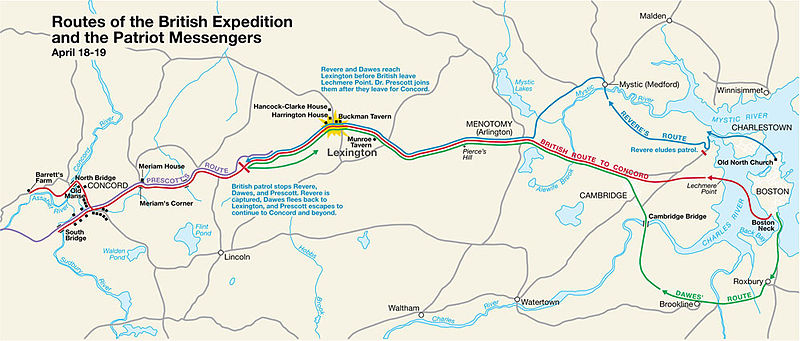
National Park Service map of troop movements to Lexington and Concord

Battle of Lexington, engraving by Amos Doolittle (1775)
Today (the Monday closest to April 19th), residents of Massachusetts (and some other parts of New England) remember our ties to the founding of the nation by celebrating Patriots' Day. This isn't a new tradition--in fact, perhaps the most famous part of the conflicts was immortalized (however romantically rather than accurately) by Henry Wadsworth Longfellow in his poem Paul Revere's Ride. I remember having the poem read to my third grade class by a man dressed as a member of the Lexington militia and talking to us about the revolution, and going to see the reenactments and parades (when I wasn't marching!).

Reenactors marching in the Lexington Patriots' Day Parade, from here

The poem, as you probably know, begins:

Listen my children and you shall hear
Of the midnight ride of Paul Revere,
On the eighteenth of April, in Seventy-five;
Hardly a man is now alive
Who remembers that famous day and year.

and continues on to describe Revere's journey, as romanticized in that charmingly inaccurate 19th century way. Longfellow concludes:

You know the rest. In the books you have read
How the British Regulars fired and fled,—
How the farmers gave them ball for ball,
From behind each fence and farmyard wall,
Chasing the redcoats down the lane,
Then crossing the fields to emerge again
Under the trees at the turn of the road,
And only pausing to fire and load.

So through the night rode Paul Revere;
And so through the night went his cry of alarm
To every Middlesex village and farm,—
A cry of defiance, and not of fear,
A voice in the darkness, a knock at the door,
And a word that shall echo for evermore!
For, borne on the night-wind of the Past,
Through all our history, to the last,
In the hour of darkness and peril and need,
The people will waken and listen to hear
The hurrying hoof-beats of that steed,
And the midnight message of Paul Revere.

Even though this isn't exactly what happened, it's the theme that we remember and celebrate. We remember the idealism and bravery of the colonists who supported a rebellion against King George because they believed in a better world (although I admit that is an oversimplification).  

spring pussy willows near my parents' house
Patriots' Day has long been one of my favorite holidays, because it is a celebration of Boston's heritage and one of the special times of year when everybody else gets excited about history too. (Or I like to think so...even though I know most people are actually excited about the Boston Marathon.) It is very difficult to go anywhere in MA without seeing signs of New England's age, even if they don't register. Stone walls instead of fences, "cowpath" narrow, windy, practically-circular streets, the normality of costumed tour guides and park service rangers chilling downtown, the plaques on houses signifying their historic status, the cobblestones, the "blue laws"...I'll stop. 

Pioneer Village: 1630, Salem
What I mean is that history is a part of the lifeblood of Boston (and New England in general) in a different way than in other regions of the country that I've been to. There is something so special about being able to go on a ridiculous bar crawl and be on a walking tour of the city at the same time, because the men who founded our country discussed their plans for a democracy over drinks in the same taverns. This probably also has to do with the fact that there are often people in 18th century attire hanging out when I've been in--and that's perhaps my favorite thing about Boston. We've embraced our history, we celebrate it, and bringing it to life is just another part of the scenery. I love being a part of that.

waving to a Swan Boat full of drag queens in the Boston Public Gardens. Nope, not even joking a little.
While I've loved living other places Boston will always have my heart, and its blatant expression of "history worship" (as Barbara so aptly put it) is a large part of that. The city is built on the strength of its community and the heights of its ideals, and maintained by the stubborn fortitude it takes to stick out a New England winter. Patriots' Day is a celebration of that to me.

Happy Patriots' Day, with love.

The Old State House, from the BU website

And because I love that 19th century romanticism, I'll leave you with Emerson's Concord Hymn, which sort of sums it up:

By the rude bridge that arched the flood,
Their flag to April's breeze unfurled,
Here once the embattled farmers stood,
And fired the shot heard round the world.

The foe long since in silence slept;
Alike the conqueror silent sleeps;
And Time the ruined bridge has swept
Down the dark stream which seaward creeps.
On this green bank, by this soft stream,
We set to-day a votive stone;
That memory may their deed redeem,
When, like our sires, our sons are gone.

Spirit, that made those heroes dare
To die, and leave their children free,
Bid Time and Nature gently spare
The shaft we raise to them and thee.


Saturday, April 6, 2013

Happy National Tartan Day!

I'm not actually doing much to celebrate (except wearing a mini-kilt, of course!), but I am writing blog posts.

National Tartan Day was put into US law in 1998, but is actually a Scottish holiday too. I guess you could say it's similar to Patriots' Day, because it's historical and not really celebrated the way actual big holidays are--but it comes from an important moment in history, and is worth remembering for that reason alone. As I've discussed on this blog before, plaid--both as an article of clothing and a pattern--has been a part of parts of Scottish culture since the Middle Ages, but gained widespread popularity and association during the 19th century. National Tartan Day memorializes the signing of the Declaration of Arbroath, which occurred on April 6 1320.

The Declaration of Arbroath, currently in the National Archives of Scotland. It became part of the Scottish archives in 1829, right in our tartan timeline
The Declaration of Arbroath was written in Latin and sent to Pope John XXII by the barons of Scotland on behalf of the "whole community of Scotland." The declaration was essentially a letter asking the Pope to recognize Scotland's independence and its king, Robert the Bruce. Struggles over Scottish independence had been ongoing for decades at this point, and convincing the Pope to support independence would greatly aid Robert's efforts to hold a Scottish throne, which he had seized in 1306.

portrait of Robert the Bruce
Courtesy of the Scottish Registry of Tartans' Facebook page, here's an excerpt, translated from the original Latin:

"As long as but a hundred of us remain alive, never will we on any conditions be brought under English rule. It is in truth not for glory, nor riches, nor honours, that we are fighting, but for freedom - for that alone, which no honest man gives up but with life itself."

Sound a little familiar? It does to me. Not the words themselves, but the message: it's the same quest for freedom we celebrate on Patriots' Day in Boston (but more on that next week). It must have resonated with the Pope too, because he wrote to Edward II (then King of England) to support peace. In 1328, England finally acknowledged Scotland's independence, and Robert the Bruce as King of Scotland.

Robert the Bruce is crowned King of the Scots by Isabella Buchanan, from a tableau at Edinburgh Castle
National Tartan Day celebrates the end of a bloody struggle in Scottish history brought about by citizens unafraid to declare their own independence in the face of the crushing English force. It also pays tribute to a national symbol that's actual history is often discussed. Did Robert the Bruce really wear a tartan kilt into battle against Edward II? Modern scholars say probably not. Regardless, tartan has a place in Scottish nationalism, and what better way to celebrate Scottish independence than that?

where tartan actually comes from...just kidding!
I've written about Robert the Bruce briefly before, when I visited Melrose Abbey (where his heart is buried!). You can read about that here!

Thursday, April 4, 2013

Months Later, A Video!

The next few weekends are full of events, so I've been simulaneously sewing regency dresses and superhero outfits...an odd combination, but I am so excited for both events!

In the meantime, Julia has posted the video of our Birds of Prey entry to the Arisia Masquerade. I am really proud of us! Click the link to her post to go check it out.

Sunday, March 31, 2013

Returning Heroes

What a busy month! And it doesn't really end...I'm in the midst of gearing up for the Regency Intensive Weekend, which will be a ton of fun! In the meantime, though, I'm taking a bit to reflect on Returning Heroes. It was a lovely evening of 1860s dancing and shenanigans...all done in my new pink plaid! I'm actually pretty happy with this dress, although it still needs a little bit of adjustment.  Better to say it with pictures, though! And in case you are burning to know why pink plaid, and not another tartan, stay tuned--there's another 1860s tartan post to come.

in the car on the way to the hall...the problem with 1860s: hoop space!

before the ball we made sandwiches, organized refreshments, and took a bunch of pictures. This is a  preview of the portrait series I'm working on

then it was time to get ready

my hair was based on fashion plates like this one


and, as usual, I wasn't done sewing. Actually, I WAS done, but then it was too long, and I had to rehem. Super frustrating.

someday I will be done before the day of an event...

sewing each other in and generally getting ready

we managed to snap a few more pictures once we were dressed. I am actually quite pleased with the way this turned out!

During intermission we did a couple of German (or Cotillion) figures as performance pieces. In this one, the gentlemen chooses a lady, she then blindfolds him and chooses someone else. He may then choose which side (right or left) he would like as his partner.

the gentleman faces his choice
I did the second, in which the lady stands on a chair holding a lit candle. The gentlemen compete to blow the candle out, and whoever succeeds is her partner. Germans are a ton of fun, and you can read more about them here

even during Germans, proper etiquette is observed


Returning Heroes is unique because it is the only ball of the year where costumes are required--look how lovely the room looks!

dancing Les Rats Quadrille

the head couples' portion of The Gothic Dance

it was great to catch up with old friends and new!


It was a lovely ball, and even though I love all the periods we do, 1860s will always have a special place in my heart. I certainly enjoyed the evening, and it seems like everyone else did too--I call that a success.

Monday, March 11, 2013

Balmorality: Queen Victoria's Tartan Craze


It's been a while, but I'm picking up where I left off in my series of posts on tartan in women's fashion! If you're new to the party and interested in pre-1840s, you can check out my earlier two posts on the Regency and Walter Scott revival at the links.

The Waverly novels by Sir Walter Scott romanticized life in the Scottish Highlands and created an image of brave clan members and determined heroines all bedecked in tartan. While tartans, or woven plaids, had been a part of Highland culture, Scott's novels and the tartan fashions that followed brought a relatively small, rural, old (medieval even) pattern to the heights of London fashion. As Scotland struggled politically and economically to maintain a national identity within the quickly industrializing mid-19th century British Empire, the romantic image of clan members in kilts and maidens in fields of heather enchanted English ladies. One particularly influential lady to be enchanted by the romantic promise of the Scottish countryside was Queen Victoria herself.

portrait of Victoria in tartan sash

Queen Victoria and Prince Albert were so charmed by the Scottish highlands that they built a castle there, called Balmoral, in 1853 (the estate was purchased in 1848). While decorating, Albert designed several different tartan setts, and Balmoral was tartan from floor to curtain.

Balmoral Castle, circa 1860s--you can see more images here

illustration of Balmoral interior, 1857

watercolor of Queen Victoria's dressing room, 1857


Balmoral (Green), 1853
Balmoral (Lavender), 1853
Balmoral, 1853
 Balmoral became a vacation playground for the monarchs and their friends, and the appropriation of many elements of Scottish tradition (such as the wearing of the kilt) were adopted by Balmoral residents during their stay. According to the Scottish Registry of Tartans, Queen Victoria had a skirt in the Balmoral tartan, and a similar sett was woven for her children's clothes. Victoria was also quite fond of the "Dress Stuart (or Stewart)" tartan, and had her own version created with a red stripe added.

Victoria Stuart tartan, a variation of Dress Stuart

This particular tartan was featured in both Victoria's clothes as well as her friends--the Princess of Wales wore it to a ball at Balmoral Castle in 1863 (which was the inspiration for my '60s ballgown last year):

photo from a later auction catalogue showing a dress in dress stuart tartan with black lace trim (likely altered from its original version)

Really, though, Queen Victoria started a trend for all kinds of tartan, not just her chosen few. Even before Balmoral, Victoria was already a fan.

dress belonging to Princess Victoria, 1835
The incorporation of tartan (or really, plaids in general) into women's fashion is evident in extant garments, photographs, and fashion plates from the period, which demonstrate a range of applications for the pattern. While Victoria was certainly a trendsetter, the use of tartan spread to America, too; its roots in Queen Victoria's Scottish infatuation (or the "Balmorality" cultural appropriation, as scholars have called it), is still referenced in the popularity of the Royal Stuart tartan.

Dress in royal stuart tartan with green fringe, c. late 1860s (whitaker auctions)


Wool day dress in royal stuart tartan, 1860s


plaid taffeta silk 1860
plaid taffeta silk, 1860

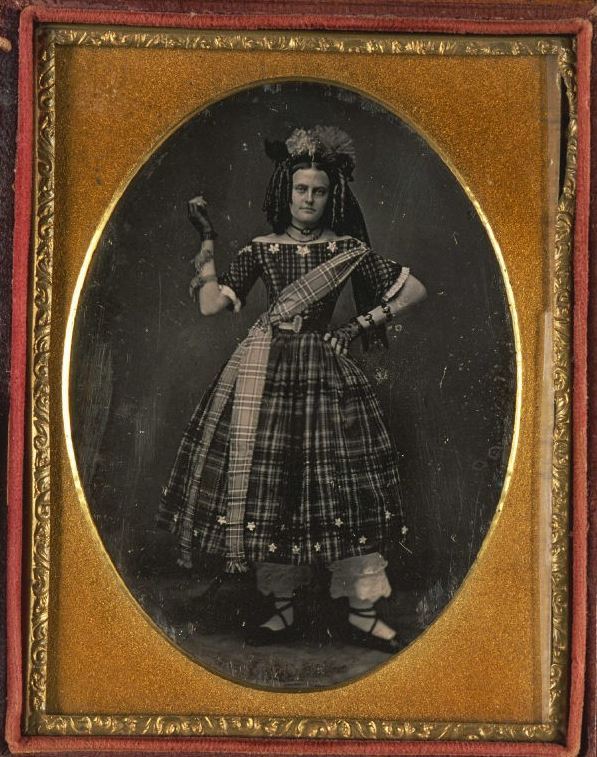
lady in fancy dress (probably Scottish), 1840-60
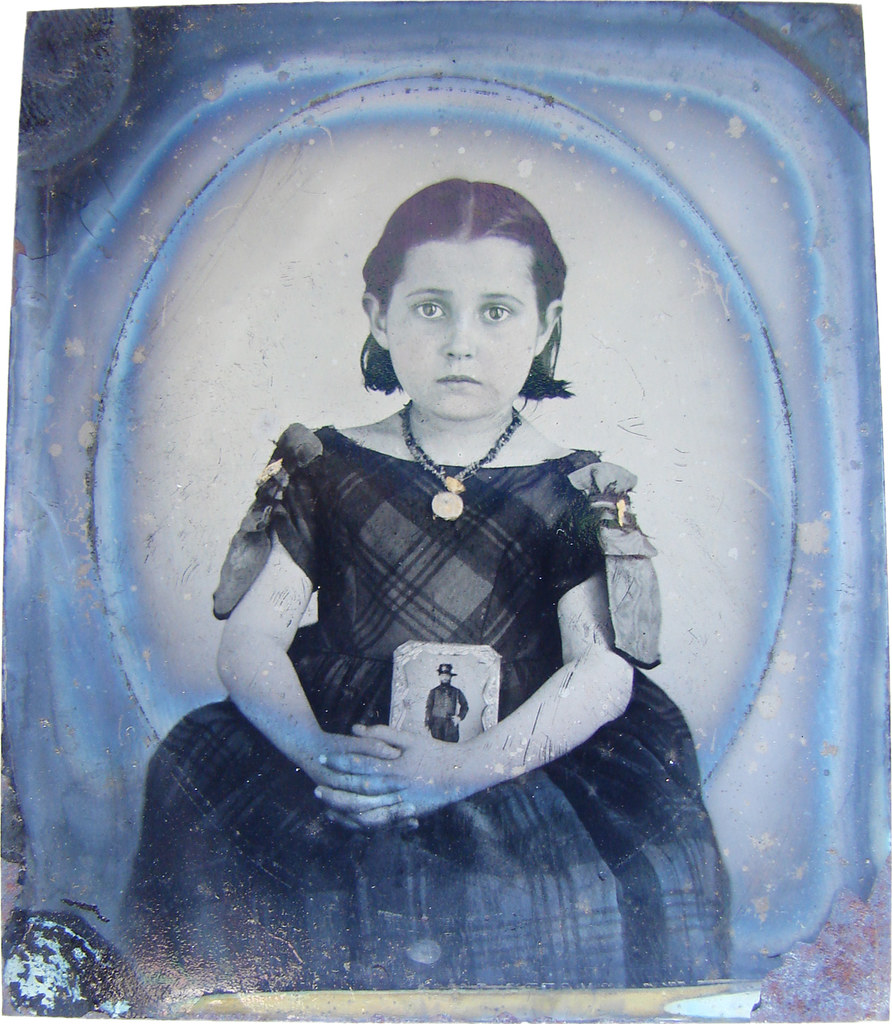
girl in plaid mourning dress, holding picture of father dressed as a cavalry man, 1860s

fashion plate depicting plaid sash, 1863
Pretty Lady cdv by Bayley & Cramer of San Francisco, California
Carte de Visite, 1860s, from San Fransisco via pinterest

1861-1865, Lovely plaid dress with really full sleeves & undersleeves; solid sleeve caps that extend to bodice center like low lapels and a wonderful hat!  Love this design.  (The small dainty figure helps!)
1861-65, via pinterest
1858. Townsend's monthly selection of Parisian costumes.  Lozenge plaid bordered with ruching.

1858. Townsend's monthly selection of Parisian costumes. Looks like royal stuart to me!


While tartan must be woven, and can therefore be a variety of fabrics, it is most commonly wool or silk. Silk being so fabulous for dresses, it is most likely that was what Victoria favored. However, we do know the woolen variety of tartan had another use at Balmoral: keeping ladies warm! A fabulous anecdote from one of Queen Victoria's ladies' maids reveals that the Duchess of Manchester, at least, owned a pair of scarlet tartan drawers. How fabulously scandalous!
Plaid was not new in the mid-19th century, but Queen Victoria's status as a trendsetter, combined with her infatuation with the romanticized Scottish Highlands, were a dynamic pair, and it's no surprise that tartan (and plaid in general) was so popular during her reign. I bet those ladies on picnics at Balmoral were quite a sight!


Wednesday, March 6, 2013

The Cottage Bonnet

I am running around like there's a fire (although actually there's an impending snowstorm. again.), but it is all exciting things you will see soon! I had to pause and share a video from the Regency Ball!

During the ball members of the Commonwealth Vintage Dancers performed The Cottage Bonnet, which is a super fun dance that involves some pretty neat steps. We caught it on video, and here it is.


Enjoy!

(and if you're in the Boston area, or able to stay for a weekend, you can learn the Cottage Bonnet too at the Regency Dance Weekend in April)

Tuesday, February 26, 2013

Rescheduled Regency

The Commonwealth Vintage Dancers  were supposed to host a Regency ball the week of the snowstorm, so it was rescheduled to this past Saturday. Honestly, after a flurry to finish my dress before the original date, my motivation was lacking to get anything done for the replacement.

Luckily, I really wanted to be clothed...and to be a princess. So I ended up with a very late night on Friday and some hectic pre-ball sewing all day on Saturday (thanks, Quinn!). The dress is totally untrimmed and has some issues, but I actually feel much better about it than I did on Saturday. It's on the docket to really finish for the Regency weekend in April, but in the meantime--the ball was so much fun! I took a lot of pictures, so even if this isn't a dress post, I can still share Pride and Prejudice with you.

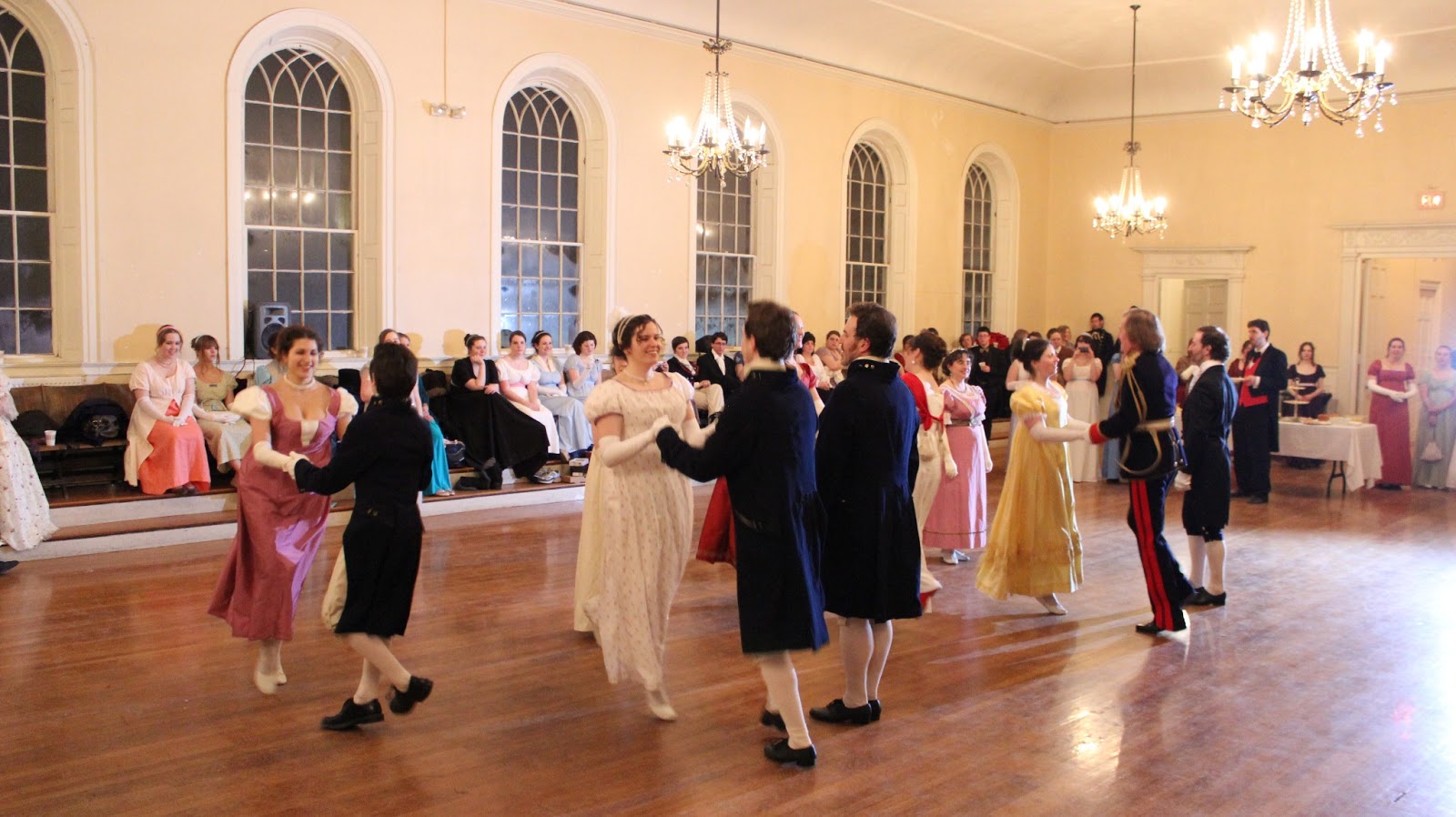
Antonia calling a dance--it was a good sized ball. Full, but not excessively crowded

This picture reminds me of a shot from a period drama

Ladies chatting before the ball. Quinn had a fabulous new dress too--check it out on her blog!

taking a dancing break

As we only used the upstairs room of the hall, at intermission the doors were thrown open and the table of food was carried in. Very dramatic! (as usual, I am making a judgey face...)

Taking refreshments


I like food pictures...sorry.


During intermission members of CVD performed "The Cottage Bonnet," a super fun Regency dance that was more complicated than what we did at the ball...and something everyone can learn at the Regency Weekend in April!


Julia kindly took my camera for a bit, so I could be in dancing pictures


After the ball we took lots of pictures, as always. Julia had fabulous hair!


being Greek Muses...sort of. 


CVD group shot! It was fun to be in color for once, as our Regency performance dresses are white

My post-ball portrait. The curls were an experiment...they looked better at the beginning of the evening, but they held up rather well.

and really, my post- post- ball portrait in which I wear my Batman sweater, have crazy hair, and look judgey. Yep, that's me.
I am so looking forward to Returning Heroes and the Regency Weekend! The ball gave me a lot of new (and much needed) motivation to sew, and I'm rolling with it...which also means a return to tartan posts. Stay tuned!