Saturday, March 25, 2017

The Nathaniel Gow Bicentennial Ball

As I mentioned in my previous post about my dress for the occasion, I was very privileged to attend the Nathaniel Gow Bicentennial Ball held in the Edinburgh Assembly Rooms 200 years (to the day!) after the original event. It was a wonderful experience!

(A Note: All photographs in this post are courtesy of the official event photographer, Juliette Lichman. Please to not copy.)


The Edinburgh Assembly Rooms were built in the 1780s in Edinburgh's New Town and renovated in 1796 to add crystal chandeliers and other decorative touches to the interior. The upstairs ballroom is lovely and light, and stands today much as it would have in the early 19th century. As historian Colin Ross explains in his podcast about the building, the Edinburgh Assembly Rooms are quite special because any changes over time were only additions, retaining the existing spaces as they were. This means that while there are more modern touches in other parts of the building, the ballroom still feels like the Regency era. This includes the original musicians' gallery, a raised alcove in the wall where the musicians (and our dancing master) sat throughout the night. The acoustics in the room are incredible, and the music could be heard throughout the ballroom without any amplification! Quite impressive given the size of the room.


the musicians' gallery
During the early 19th century, the ballroom in the Assembly Rooms saw many balls, celebrations, political gatherings, and readings and banquets hosted by authors like Sir Walter Scott and W.M. Thackeray. A few years after the ball we were recreating, the ballroom hosted King George IV during his first visit to Scotland in 1822. A book written about this trip gives a glimpse into what the Assembly Rooms would have looked like quite near 1817, so I thought I'd share a bit:

"The principle ballroom is of magnificent dimensions and fine proportions, being 92 feet long, 42 feet wide, and 40 feet high; and its decorations, which are characterized by simplicity, lightness, and elegance, rather than by richness, consist of handsome fluted pilasters, of the Corinthian order, resting on the floor and supporting the cornice of the room; the centre of the south side is enriched with Corinthian columns of smaller dimensions, forming the decorations of the entrance, and supporting a balcony for the orchestra...and the elegance of the whole is summed up in the rich cut crystal lustres suspended from the ceiling."


Mudie's illustration of the Assembly Rooms-G is the main ballroom. Also interesting to note that S, the second ballroom, was "on this occasion appropriated to quadrilles." Other rooms connected to the ballroom were for playing cards and taking refreshments. 
In addition to the room, I greatly enjoyed the amount of tartan in the ballroom! And because I cannot beat his description, Mudie writes of the 1822 event:
"At nine o'clock, the room was completely full by nearly all the rank, beauty, and fashion of Scotland...The Duke of Argyll was conspicuous in the dark-green plaid of the clan Diarmid; and other noblemen and gentlemen gayly disported themselves in the mountain garb*. The scene was one of such extraordinary splendor as almost to entrance, at least to bewilder, the faculties in contemplation of it. The surpassing beauty of the ladies-their plumage, in constant undulation, appearing to the eye like an ocean of foam;-the glitter reflected from a profusion of jewels;-...the room itself;-altogether presented a scene which more than realized all previous conceptions of grandeur and magnificence."


  The ball itself was quite special beyond just being held in a magnificent space, as we were dancing the same program as the original ball in 1817. In 1817, the ball was played and called by Nathaniel Gow and his band. Nathaniel Gow, son a of a famous Scottish musician, was himself a violinist and composer sought after throughout Scotland to play at fashionable gatherings (actually he was also present during the 1822 visit Mudie describes, and received particular compliments from the king). Gow was also in demand in London, and thus saw many popular dances that may not have made it to Scotland yet. Quadrilles were a particular fad in the late 1810s and early 1820s, and Gow is credited with introducing many of them to fashionable Edinburgh society. It was some of these "favorite French quadrilles" of Mr. Gow that we were recreating at the ball.

standing up for a quadrille
Dancing at this ball was an interesting experience for me. I was very glad to attend the workshop earlier in the day, because historical dance is subject to variation based on the particular reconstruction of the source material. Dance manuals and music with instructions are amazing resources, but there's still room for interpretation (not least of which being the cultural lens of the historian) that can lead to differences between what I would do at home in Boston and what Stuart Marsden, our instructor for the evening, would teach. And there were differences! Most notably, Mr. Marsden instructed in French for the French quadrilles. While we do use French terms for some steps and figures, most of our calling at home is done in English--so having to remember the French terms took some getting used to!

our dancing master in the musicians' gallery
Many of the figures were also new to me. I know one of the earliest sets of quadrilles published in the UK, known as the "First Set"**, and some of these figures appeared in Nathaniel Gow's set as well-but with a few changes. According to Mr. Marsden, these changes were made by Gow to help the Edinburgh audience learn the figures when they were first introduced. So similar to what I know, but a little different! This was quite fascinating to see and hear discussed.

ladies hands round while men circle outside, part of a quadrille figure
I also really enjoyed the quadrilles that were totally new! My favorite was called "La Caprice" and included a mix of typical quadrille figures with waltz--the music changed to waltz time (3/4) for just that section of the dance each time it was repeated. So cute! This also makes sense as a novel figure for 1817, when quadrilles were still the dances of the young and energetic, "resisted by others, such as the 'old fashioned respectables'...[at] parties in Edinburgh" (Stapleton, see below) and the waltz was still newish and more accepted by young people as well.

in lines for a country dance
During one of the breaks there was also a performance of a traditional Scottish dance with music by the event's organizer, Talitha. I enjoyed watching this, and it was an interesting call-back to some of the tension in fashionable dancing of the period, when dances had a more national associated (French Quadrilles, Scotch reels and strasthpeys, German and French waltz). Many UK dancing masters call out the particularities of Scottish dancing in relation to quadrilles, and encourage the preservation of reels and strasthpeys--while bemoaning the attempt of Edinburgh musicians to play quadrilles to reel music: "If Ladies and Gentlemen wish to have their music played in such a ridiculous manner, they only, by so doing, show their ignorance of the refined delicacy of the Quadrille." Ha!

performance of a traditional dance
In general I greatly enjoyed the dancing, although it was certainly a marathon of complex steps and a rapid pace. This was also the first ball with a full supper (two breaks in fact-one for the main meal and one for dessert!) I have attended, and that was a neat, historical experience as well. I'm very grateful I was able to attend with a dance friend, so that I had a partner who I could totally nerd out with about historical dance reconstructions--the gossip is always the best part!

chatting before a country dance
Notes:

*From a tartan history perspective, I can't resist pointing out that Mudie notes the tartan ensembles as "mountain garb" here--tartan is still more of a highland thing (and the ball was in the lowlands)--something separate from the "elegant dress [and] usual court dress" worn by most of the attendees. This is changing by the mid-century, with Victoria and Albert in Balmoral.

**Payne's First Set, published 1814-15 or Paine's First Set, published 1815-1816; they're the same figures, but Paine adds another. (Those were two separate dancing masters, not different spellings of the same person's name.)

For more on the 1822 royal visit, check out Mudie's book, A Historical Account of His Majesty's Visit to Scotland

For more on Nathaniel Gow and Regency dance in Scotland:
Regency Dances site
Stapleton, A.M. (2014). Pointed Encounters: Dance in Post-Culloden Scottish Literature. Google Books.

And Regency dance in General:
Capering and Kickery
Mr. Marsden's site

Tuesday, March 14, 2017

Dressed for a Ball, 1817

Every now and then the stars align rather perfectly, and that happened this past Saturday for me. Many months ago, I found out my grad school endeavors would be taking me to Scotland for 10 days; mostly in the rural highlands where the class would be working, but with a final day in Edinburgh before heading back to the States. I wrote to a dear friend (and now rather long-distance partner in historical adventuring) who lives there to make sure I'd be able to see her...and found out that I'd be in town on the day of a rare event: a Regency ball! Obviously, we'd have to go.

And I'd need a dress.


I'll write a post dedicated to the event itself, which was held in honor of the bicentennial anniversary of a ball held in the Edinburgh assembly rooms on the same date in 1817. Once I get pictures of the ball from the official event photographer (the utterly awesome Juliette), I'll write more about it. In the meantime, dress!

the Edinburgh assembly rooms before the ball
I struggle with Regency, and as a result I've never had clothes for the period that fit me well. Eventually I just sort of halted on making anything new until I had stays that fit, because I had a feeling my lack of acceptable structure was a large part of the problem. Now that I finally do have stays I like (not made by me), I was excited to make some new things to go over them...and this ball was a perfect opportunity!

yes this is a picture of me, but seriously-the tartan behind me is the important part!
Having fallen in love with this 1823 fashion plate, I had my inspiration. Of my existing dresses I have always liked the fit of my first-ever Regency dress best, which I made using one of the dresses in Janet Arnold's Patterns of Fashion. So back to the source I went, and started with Arnold again for this dress.

sleeve and bodice detail
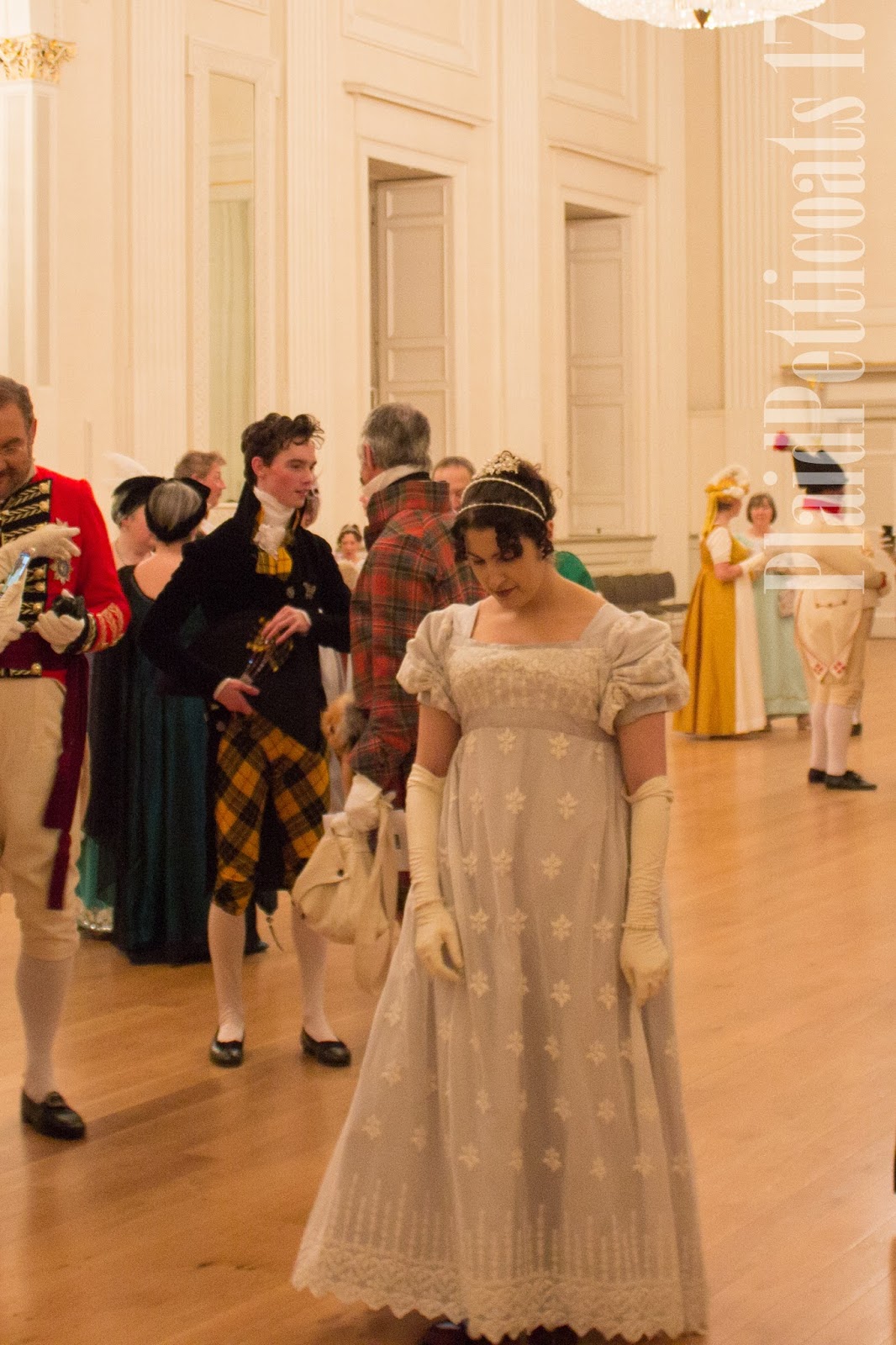
After getting the pattern right (which included many tears...ugh), the construction itself was pretty straightforward. The embroidered net and silk for the main bodice pieces were sewn as one with the lining, and then attached to the bands that form the neckline. The sleeves are similarly assembled (with a lot of piecing, because I was running out of embroidered net!), but unlined. The vertical gathers were totally wung (winged?), but I'm really really pleased with the way they came out! The sleeves are actually long rectangles that I gathered horizontally/normally into the armscyes and plain silk bands as well as gathering vertically in four places. The net and silk skirt layers were sewn separately but attached together to the waist, which is a teensy bit wider/lower because I was aiming for the later part of the period given the 1817 anniversary.

the full effect (sorry this one's a bit blurry)
 Given the lovely gilded details of the room, I gave in to temptation and blinged out, although given I'd had very limited packing space I think it was still pretty restrained. I pin-curled my hairline using LBCC lavender pomatum and then just pinned the rest of it up at the crown of my head. I didn't get any great pictures of the silver floral bit on the front of my bun/curl pile, but the idea was inspired by this painting:
portrait by Johann Peter-Krafft, 1817
And of course, I couldn't possibly go to a ball in Scotland without at least a little bit of tartan! Since I wasn't making a tartan ballgown, I settled for tartan shoes.

tartan shoes and silver and pearl hair branch
I joked that the gathered sleeves were my "pretty pretty princess" sleeves, but I definitely felt elegant and princess-like dancing in the assembly rooms! You'd never know that just an hour before I'd been frantically hemming like the wind. (Some things never change.)


making new friends...

and cherishing a good gossip with old ones
I'm already looking forward to wearing this again for the Regency Weekend in April!

Wednesday, March 1, 2017

On a Positive Note: Sleeves!

Well, after a very long and stressful half-week, I can say that my new regency ballgown is done except for some handwork (interior finishing, hem, closures). What relief! This has been one of those projects where nothing seemed to go right. All said, though, I think it's going to work out in the end (but as I haven't had a final try-on yet, I shouldn't say that too loudly!). After my slight internet-public meltdown the other day, I thought I'd share my favorite part of this dress as a happier note to leave you with.

sleeves!
Several months ago, I happened upon this 1823 fashion plate from LACMA:


I loved the simple silhouette dressed up by the embroidered over-layer, and the contrasting/plain bands on the waist and sleeves. I was also drawn to the vertically-gathered sleeves, which are just a hint of Renaissance revivalism. (I've been on a Renaissance-inspired poofy-sleeve kick I think-the Rgency day dress I'm planning is similarly princessy.)

I've never made sleeves with vertical poofs like this, and after the hellish assembly process for the rest of the dress I'll admit I had a moment where I almost bailed. But the sleeves were my favorite part! I couldn't give up! So I didn't, and I'm glad.

Of course, because this is dress is trying to drive me mad*, I didn't actually have enough embroidered net left to cut sleeves. After a lot of fussing I ended up piecing the scraps I had into something usable, which worked quite well-plan B was to use leftover tulle from my 1830s dress.

the layers of one sleeve pinned for basting--you can see the piecing seams here
 Given my precious little fabric, I should certainly have made a mockup first...but I didn't. Dangerous living! Although to be fair, I used the same basic strategy I always use (measure the armscye and double it) for a basic puff sleeve, so I was pretty sure I'd be ok. To each basted rectangle I added four vertical lines of gathering stitches while it was still flat so it would be easier to sew.
gathering stitches
Then I made the rectangles into tubes, added gathering stitches to the top and bottom openings, and started pulling the verticals.

scrunchy poofy tube!
Finally I gathered it into the armscye as usual. At some point I decided I didn't like the pointed edge after all (I am weirdly not one for ruffles in this period), so I cut the very edge of the net off and added a solid band of silk.

The jury's still out on how these will wear, but all in all I'm quite pleased with them. So that's one thing to feel good about as I pack this up and pray to all the travel deities that my luggage isn't lost!

pooftastic!
 *I've started mentally referring to this dress as Elsa, because it reminds me of icicles and is a little bit evil without meaning to be. I'll get over it once I wear the thing...or should I say, I'll Let It Go?

Monday, February 27, 2017

I Hate Regency, or, Ball Gown Progress

Ok guys, I've got my ranty pants on...

I had this great idea.


via GIPHY

After acquiring some fantastic new stays that are super comfy and keep all the things where they're supposed to go, I thought it would be nice to have some Regency gowns that also fit me well to go over them. A great idea? A great idea!


via GIPHY

So as I started working on a new Regency ballgown for an 1817 event I'm attending in a couple of weeks, I was careful to start from the beginning. I re-drafted the bodice pattern up from Patterns of Fashion (which I've used previously and liked), made a mock-up, fit it, made a second mock-up to be sure, and then started sewing my dress. And somehow, even with all of that, I've ended up re-cutting the shoulder bands twice, unpicking and re-stitching the back three times, and just generally had basically nothing go according to plan.

"You'll have such a solid Regency bodice pattern at the end of this, though," I keep reminding myself. But still. Why is getting Regency to fit so much harder than any. other. period?


via GIPHY

So with some help from The Boy, I got into stays and tried the sucker on again tonight, re-did the shoulder bands again, and finally got something that fits. Hooray! But the angle doesn't match my stays, and they show at the back. Boo!

back problems :/ (the puckers are from pins in the interior)
For the ball, I'm just going to piece in a curved bit of silk to fill in the gap and cover my stays-then I can trace a new shoulder strap pattern piece that incorporates a wider back bit after the ball, when I'm not pressed for time. Because tomorrow sleeves need to go on! At least the fabric is lovely (icy gray-blue silk with embroidered white net over top), so I will look somewhat elegant regardless.

Bah humbug.

the bodice with straps pinned in place-at least my stays are fully covered in front! sleeves tomorrow.
the wretched thing in full.
I know that I'll be happy to have something that fits well in the end, and since I'm carefully keeping the pattern up to date with changes, I'll also have a pattern that fits well to make future dresses. Worth it--even if I'm frustrated now. So I'm taking a break, cuddling with the cat, and ranting on the internet. By tomorrow evening hopefully I'll feel better, and can knock out sleeves without fuss. But tonight...tonight I'm watching Austenland and moping.


via GIPHY

Friday, February 10, 2017

Liebster Blog Award!

I'm trying to have 2017 be a year of cleansing, and that means cleaning out my drafts folder too! Cassidy, fabulous author of A Most Beguiling Accomplishment, nominated me for a Liebster Award back in June. If you're unfamiliar with the rules, each nominee is asked to answer their nominator's interview questions, nominate 11 bloggers with less than 200 followers for the award, and offer interview questions for them to answer, should they choose to accept the mission. Cassidy has some great questions, and I've been working on answers!

let the interview begin!

What is the history mystery (including but not limited to historical fashion) that you would most like to solve?
What is the period or area of historical dress that you first began to concentrate on?
I don't do much of it anymore (so many periods! so little time!), but my first period was the 1860s (American Civil War). In middle and high school I was in a group of living history volunteers in the greater Boston area that researched, constructed, and performed local programs. One of our main periods was the 1860s, and the clothes really spoke to me. I started with day wear, and then evening dresses when a friend introduced me to vintage dance. 

Do you belong to a costuming or reenacting group?
I do! If you'd like to experience a social evening in your favorite period, get into the past for the weekend, or just learn some really fun dancing, you should check out the Commonwealth Vintage Dancers. Most of the outfits and outings I post about involve CVD or CVD friends. The group is a non-profit organization devoted to the study and reconstruction of period dances, including performances and participatory events where we teach. 
I am lucky enough to live in an area with many vintage-themed groups, so I have my pick of events from the Greater Boston Vintage Society and Tweed Outing ClubI have also attended World War II events as a member of the Big Red One Living History Organization, and hope to get involved with the 1st WAC Separate Battalion soon!

What is an area that you fancy studying or sewing that you do not currently do?
 I'd also love to try out a bustle ensemble sometime! But as I don't attend any events in that era, it's not been a high-priority project. There are also some 1950s dresses on my wish list, but somehow I never get to them. Maybe this year... :)


costume sketch by Edith Head for Rosemary Clooney in White Christmas: inspiration for a 50s project that's been on my list for years!

Is there a particular technique that you'd like to learn, but haven't had the time or a project to do it in?
I would love to learn more about tailoring! There are a couple of 1910s suits on my wish list, but I don't feel like I know enough about tailoring to hit that yet. I think if I were less intimidated I might move those projects up the list. One is a suit inspired by a photograph from the family archives, so I really want to do it justice.

What would you make if time and budget (and event) were of no concern?
Something heavily embroidered, probably Regency but maybe 1890s? I used to do 19th century embroidery to moderate my stress in college--mostly little samplers and things but I did do one Regency ball gown! Now I just never feel like I want to commit to the time and fore-planning a project like that would take, but I'd love to someday.

Is there a particular museum exhibition you'd like to go back in time or travel across the world to see?
I love museum exhibitions, and so this was a hard question! I was tied on two. First, I think I would pick the Paris Salon of 1877, in which May Alcott's still life was displayed. After years researching and playing May, I would love the chance to attend this moment, which was one of her most public successes. Second, how cool would it be to attend the Great Exhibition of 1851?! It would be an incredible opportunity to see a moment where science, industry, innovation, and fashion all collided during a turning point of the industrial revolution.

still life by May Alcott, courtesy of LMAMA
What's your favorite reference book or fashion history text?
I have two again: for actual support with construction, the first place I look is always Janet Arnold's Patterns of Fashion. Even just seeing the pattern pieces can help me determine if I'm aiming for the right shapes. For inspiration, I love 19th Century in Detail from the V&A. It's one of my favorite sources for trim, cool fabrics, and interior shots.
I'm also a huge fan of museum catalogs-either as a way to take home exhibits I really loved, or to get a glimpse of exhibits I couldn't see. Impressionism and Fashion from the Metropolitan Museum of Art is a great one.

If you could design your perfect historical reenactment event, what would it be like and where?
ooooh, great question! I would love to organize a series of events that focus on the diversity we usually don't see represented-a variety of people representing different classes, in different jobs, of different races...basically, what somewhere like Boston would have "actually" looked like. There are some people doing great work to this end already, so I hope to attend some of their events! 
I'd also love to flip the traditional timeline event (which typically includes military units) on its head and do a women's history timeline that invites living history groups and military units (like WWII WAVEs and WACs) that are primarily focused on (and lead by) women.

What motivates you in your historical recreation and/or public education?
I've always loved history, and the more I learn about where we've gone before (especially regarding technology and cultural trends), the more I recognize the cyclical nature of our experiences. I want to share that recognition with others, in hopes that we can all learn from the past. Also...it's fun! Getting to learn through experience while wearing great clothes is hard to beat :)

Do you like reading historical and/or classic fiction? (For the latter, I include any old books, whether or not they're critically esteemed.)
I don't read much historical fiction anymore, although I used to quite a bit. I do still read a lot of classic fiction. Although to be honest, as I'm currently in grad school I don't read much at all. In between semesters I marathon through books before I have to start homework again! This break I re-read Persuasion, and went on a women in STEM non-fiction kick with Rise of the Rocket Girls and Hidden Figures


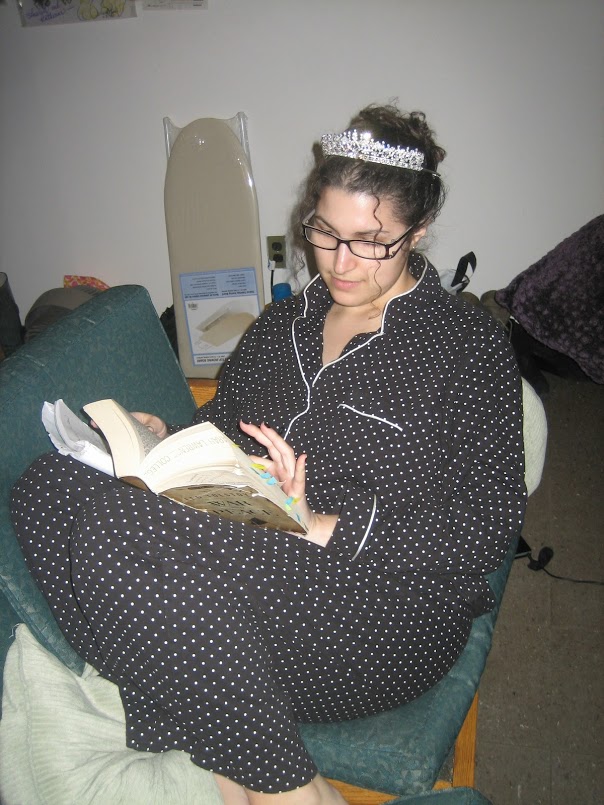
a throwback-reading War and Peace in a tiara...as you do.

I am cheating slightly and posting fewer than 11 nominees, because it turns out that most of the blogs I read have more than 200 followers! So here they are:


Our Girl History-I love reading Eliza's posts on working at a historical sight, and her thoughts on the role of women as both historical voices we need to interpret and as interpreters dealing with the public. 

Ballgown In a Backpack-Emma just started blogging, but so far her posts have been entertaining and interesting! I look forward to seeing what else she pulls out of the bag. Puns!

Fishy Fashion and Maritime Modes-This is a topic I don't know anything about, and it's interesting to see how material culture is re-created and examined...as well as how modern people respond!

The Laced Angel-ok, this one is slightly out of the follower limit, but I get some much hair inspiration from here that I couldn't leave it off!

The Quintessential Clothes Pen- Quinn does such a good job documenting her sewing process and construction! Plus, her insides are as neat as her outsides :)

Here are my questions for you all, should you choose to participate:
1. How did you start making historical garments?
2. What is your favorite part of blogging?
3. Describe a time you struggled with a historical project. What did you learn from the experience?
4. If money and restoration were no object, what piece of historical technology would you love to try using? 
5. Do you watch or listen to anything while you sew? If so, what is your favorite background?

Thursday, February 2, 2017

Late Regency Pelisse Inspiration

The Regency season is upon me! Or rather, I have a bunch of Regency events coming up (wooo! exciting!), and I will be a much happier dancer if I have new clothes. Due to ongoing undergarment problems, I've held off on making any new Regency ensembles. That was definitely the right decision, but now that my silhouette is sorted, I'm excited for some new frocks!

in a very old frock at the 2016 Regency Weekend-a frock that was only every supposed to be a pattern test, but then I never made another one!
In the plans are three new garments: a ballgown, a day dress, and a pelisse. My grand plot is to work out a base dress pattern with gathered front and plain front options that fits me really well, and that I can use as a base for any future Regency projects. To accomplish this I'm starting with Janet Arnold, because there happens to be a dress in Patterns of Fashion that fits me really well. I'm in the process of mockups right now, but I'm also planning that third piece. A pelisse has been on my list since I started doing Regency in 2012...and I've had the fabric for one since then too!

Yep, I admit it, this is a long-time stash project. I bought grey-blue velvet and pumpkin taffeta for a pelisse during a sale on New Years Day 2013. The pretty pile has been languishing in a tub ever since, in three different apartments. So I'm thrilled to finally be starting this project!

I haven't totally figured out the exact details, but I'm leaning towards a "van dyked"/pointed motif. Here are my inspiration images, which (almost) all include a base color and contrasting color:

fashion plate, 1822
La Belle Assemblee, 1817
La Belle Assemblee, 1818
The Mirror of Fashion, 1815
Ackerman's Repository, 1818
I am especially leaning towards the first image (white with blue), but I want a larger collar so there will definitely be some other elements. I'll just have to see what I'm struck by once the base garment is up and running!

Thursday, January 5, 2017

A Note of Thanks

It is customary at the turn of the year to review sewing accomplishments and set goals for the upcoming year. This year, I'm not going to set any new goals because really, I just started following by 2015 goal to take my time and not skip steps of projects...and it's going well! So I'm going to work on keeping that up, rather than making new goals.

I'm also not going to do my standard month-by-month sewing review, because honestly, I didn't make that much this year. I made a few big projects well, and I'm happy with that. Instead, here is a review of my top five adventures!

5.
Gathering this fall for an 1860s weekend, I got to focus on my photography--it was a stressful Fall, but a fun interlude!

4.
The Boy came along for a summer 1920s adventure! He won't be making regular blog appearances, but sometimes it's fun to have him join me in the crazy for a bit :)

3.
I participated in the Historical Sew Monthly for the first time! I didn't actually blog about many of my entries, but it was a blast to be part of the HSM community and to see everyone's projects.

2.
My Starfleet crew is fierce, brilliant, and coming for you. I love that our crew grows every year!

1.
An adventure of palatial proportions (heh...sorry...) to Versailles--this isn't top of the list for its location, but because it was a chance to do something really insane with some of my favorite people. And to make new friends along the way!

I'm grateful for a year full of new and old friends, new and old places, and willing photography subjects. I started off 2017 with a meeting of awesome historically-minded women, and I hope that is the first of many! I hope all of you have things to make you feel optimistic about the coming year, even when the outlook is bleak. I look forward to sharing more adventures with you. Here's to a new year!